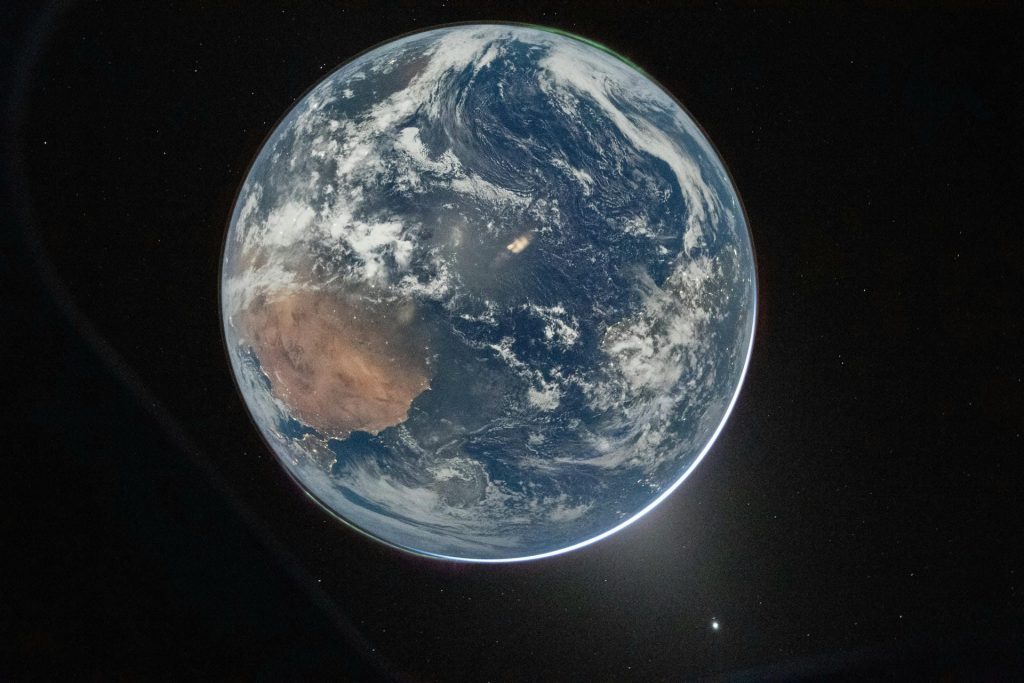
On a moonless night far from city lights, you can see a faint band of light arcing across the sky. It looks like spilled milk, which is exactly what the Greeks called it: gala, milk. That band is the edge-on view of a disk containing 200 billion stars, and we are inside it.
The Short Answer
What is the Milky Way? It is the galaxy we live in: a barred spiral of stars, gas, and dust roughly 100,000 light-years across and about 1,000 light-years thick at the disk. The Sun sits about 26,000 light-years from the center, on the inner edge of one of the spiral arms, orbiting once every 230 million years.
The name applies to both the galaxy and the visual band. They are the same thing, seen from different angles — one from outside (conceptually), one from our position inside the disk.
A Barred Spiral, Not a Plain Spiral
For decades the Milky Way was drawn as a simple spiral with four arms. Infrared surveys in the 2000s changed that. There is a straight bar of stars across the center, about 27,000 light-years long, and the arms trail off its ends.
The current best map shows four major arms — Norma, Scutum-Centaurus, Sagittarius, and Perseus — plus a smaller local arm (Orion) that contains the Sun. We are not in a major arm. We are in a spur between two of them, which is probably a good thing: dense arms have more supernovae and more disruptive radiation.
What the Dark Lanes Are
The dark patches cutting through the bright band are not gaps between stars. They are clouds of dust — grains of carbon and silicate, roughly the size of cigarette smoke particles — blocking the light behind them. Dust absorbs blue light more efficiently than red, which is why the Milky Way’s center looks yellowish and its edges look bluish.
This dust is also why we could not map the galaxy for most of history. Visible light from the galactic center is blocked by about 30 magnitudes of extinction. Infrared sees through it, and that is how we finally learned the shape.
What Is at the Center
| Property | Value |
|---|---|
| Diameter | ~100,000 light-years |
| Disk thickness | ~1,000 light-years |
| Stars | 200 to 400 billion |
| Sun’s distance from center | ~26,000 light-years |
| Sun’s orbital speed | ~230 km/s |
| Central black hole mass | 4.3 million Suns |
| Age | ~13.6 billion years |
The central black hole, Sagittarius A*, was imaged by the Event Horizon Telescope in 2022. It is quiet now, but the orbits of stars whipping around it at 8,000 km/s proved it was there long before we could see it. Andrea Ghez and Reinhard Genzel won the 2020 Nobel Prize for that work.
How We Know the Shape
We cannot photograph our own galaxy from outside. Instead we count. Star counts in different directions reveal density. Radio observations of hydrogen at 21 cm see through dust. Radio telescopes map molecular clouds. The Gaia mission has measured precise positions and motions for nearly 2 billion stars, which lets astronomers reconstruct the three-dimensional structure and even the galaxy’s history of mergers.
Gaia’s data revealed that the Milky Way is still digesting smaller galaxies. A dwarf galaxy called Gaia-Enceladus merged with us about 10 billion years ago, and its stars form a distinctive blob in the halo.
What “Milky Way” Does Not Mean
A common confusion: the Milky Way is not the whole universe, and it is not the only galaxy. It is one of an estimated 200 billion galaxies in the observable universe. Andromeda, our nearest large neighbor, is 2.5 million light-years away and roughly twice as massive.
Also, the Solar System is not at the center. We are in the suburbs, about halfway out. The galactic center is 26,000 light-years away, and the far edge is another 74,000 beyond that. Most confusion about what is the milky way comes from mixing up three things: the band of light, the galaxy that produces it, and the universe that contains both.
The Coming Collision
Andromeda is approaching at 110 km/s. In about 4.5 billion years the two galaxies will merge into a single elliptical galaxy, sometimes nicknamed Milkomeda. The stars will almost certainly not collide — the space between them is too vast — but the gas clouds will, triggering a burst of new star formation. The Sun will be a red giant by then, so nobody will be watching.
Keep Exploring
- What is a light-year? — how we talk about distances this large
- What is a black hole? — the object at the center of it all
- What are constellations? — the nearby stars, and why they look grouped

1 thought on “What Is the Milky Way? Our Galaxy, Explained From the Inside”