—
Stars twinkle because their light passes through Earth’s atmosphere, and the atmosphere is not still. It is a stack of moving air layers, each with a different temperature and density, and each one bends the starlight a little differently from moment to moment. A planet does not twinkle, for the same reason a candle on a distant hill flickers while a candle in your hand stays steady: the closer one sends you more light from more directions, and the flickers average out.
What twinkling actually is
The technical term for twinkling is stellar scintillation. It is not the star changing brightness; the star is as steady as a nuclear furnace can be. What changes is the path the light takes through the atmosphere.
Light travels in straight lines through empty space, but when it enters a medium of changing density — like air — it refracts, or bends. A pocket of warm air is less dense than a pocket of cool air, and the boundary between them acts like a weak lens. As these pockets drift across the line of sight, the star’s image moves slightly and its brightness fluctuates. Your eye averages this over a fraction of a second and reads it as a twinkle.
The effect is strongest when the star is low in the sky, because the light passes through more atmosphere at a shallow angle. A star directly overhead passes through roughly one “air mass” — the equivalent of looking straight down through the entire atmosphere. A star near the horizon passes through forty air masses, and forty times as many turbulent layers, which is why stars on the horizon twinkle more dramatically than stars overhead.
Why planets do not twinkle
Planets are much closer than stars, and that proximity gives them a larger angular diameter — the angle they cover in the sky. The angular diameter of Jupiter is about forty arcseconds. The angular diameter of a typical bright star is about one arcsecond, and many are far smaller. Jupiter covers an area in the sky roughly 1,600 times larger than a star.
That size difference matters because atmospheric turbulence affects different parts of the image independently. A star is so small that all its light passes through essentially the same turbulent cell at the same time, so the whole image flickers together. A planet is large enough that different parts of its disk pass through different cells, and the flickers from different parts average out. The result is a steady glow instead of a twinkle.
This is why the first thing an astronomer does when identifying a bright object is ask whether it twinkles. If it does, it is almost certainly a star. If it does not, it is probably a planet. The rule is not absolute — a planet very close to the horizon can show mild twinkling — but it is reliable enough to be useful, and it requires no equipment.
What you can see tonight
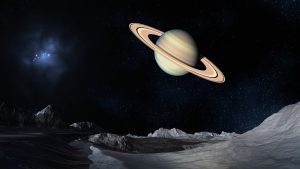
The brightest objects in the evening sky in late 2026 are Jupiter and Saturn, both in the southern sky after sunset. Jupiter is the brighter of the two and does not twinkle. Saturn is dimmer and also steady. Compare either to a bright star like Altair or Deneb, which are in the same part of the sky and flicker noticeably. The difference is visible to the naked eye, and it is a genuine astronomical observation — not an illusion or a trick.
If you have binoculars, the test becomes even clearer. A star remains a point of light in binoculars. Jupiter resolves into a tiny disk, and on a steady night you can see one or more of its four largest moons as pinpoints of light nearby. We described how to find your way around the sky in what the Milky Way is and how distances are measured in how we measure distance in space.
Why blue stars twinkle more than red ones
Not all stars twinkle equally. A bright blue-white star like Sirius — the brightest star in the night sky — often shows rapid, colourful twinkling, flashing red and blue as you watch. A red star like Betelgeuse, by contrast, usually flickers more gently and stays closer to its natural colour.
The reason is that the atmosphere bends different colours of light by slightly different amounts, a phenomenon called chromatic dispersion. Blue light bends more than red light, so a turbulent cell separates the colours for a fraction of a second before your eye mixes them back together. The faster the flicker, the more obvious the colour separation. Blue stars emit more blue light, so the effect is stronger. Red stars emit mostly red and infrared, so the dispersion is smaller and the twinkling looks steadier.
This is also why planets, which are already steady, never show colour flashing: their disks are large enough that the dispersed colours from different atmospheric cells overlap and cancel out before they reach your eye.
Twinkling and the weather
The amount of twinkling is a useful indicator of atmospheric stability, which is why astronomers care about it professionally. A night with strong twinkling is a night with turbulent air, and turbulent air produces blurry telescope images. A night with little twinkling — when even low stars are steady — is a night with laminar air flow, and that is when observatories take their best data.
For a homeschool observer, this means that the sharpest views of the Moon and planets come on nights when the stars are not twinkling vigorously. If you are planning a session with a small telescope, check the stars first. Steady stars mean steady seeing.
A five-minute observation exercise
On any clear night, find the brightest non-twinkling object in the sky and the brightest twinkling one. Time how long you need to watch before you are sure which is which — it is usually under ten seconds. Then note their positions relative to each other and check an app or chart the next day to confirm their identities. The non-twinkling object will be a planet. The twinkling one will be a star.
This exercise requires no equipment, no preparation, and no special location. It works in a backyard with streetlights, though darker skies make the comparison easier. What it teaches is that the atmosphere is an optical system with real properties, and that those properties can be observed directly rather than read about in a book. For more on what happens when objects enter the atmosphere from space, see what a meteor shower is.