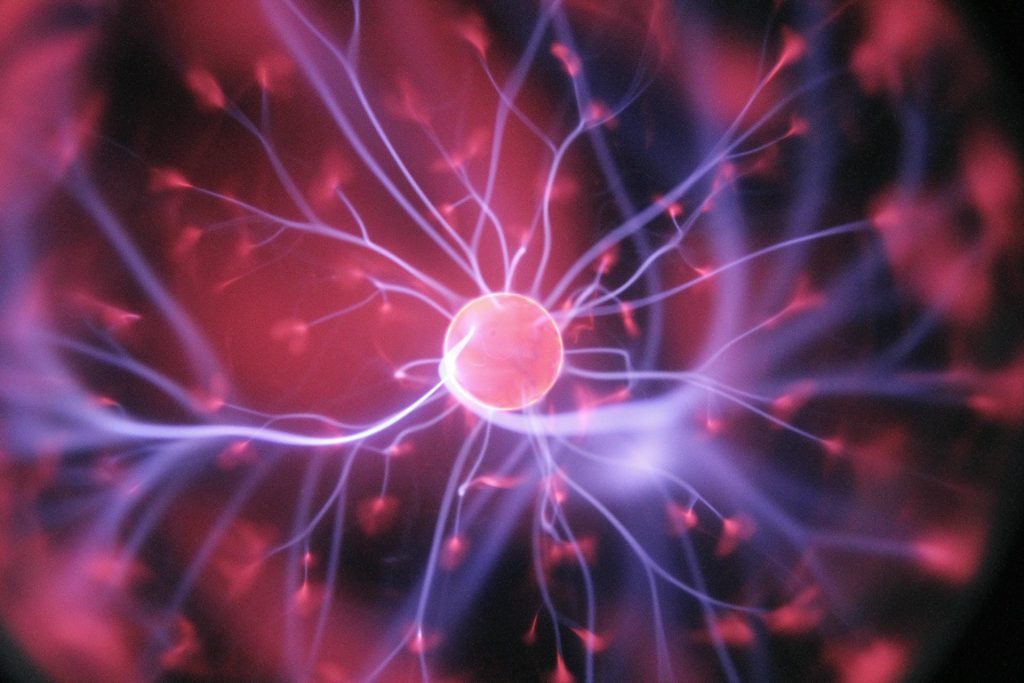
What is static electricity? It is electric charge that has piled up on a surface and is staying there, instead of flowing as a current. “Static” is the operative word — the charge is parked. The zap you feel from a doorknob is that parked charge suddenly finding a way out.
Where the Charge Comes From
Everything is made of atoms with positive protons in the middle and negative electrons around the outside. Normally the counts balance and the object is neutral. But electrons on the outermost edges can be physically scraped off one material and onto another.
That is what rubbing does. Pull a sweater over your head, scuff socks across carpet, or slide off a car seat, and you are transferring electrons by direct contact. One surface ends up with extra electrons (negative), the other short of them (positive).
Why some materials give up electrons more easily is captured in the triboelectric series — a ranked list of how greedy each material is. Rub two things far apart on that list and you get a big charge separation. Rub two things close together and almost nothing happens.
Why the Shock Happens
Charge wants to even out. Once enough imbalance builds — often several thousand volts — the air itself stops being a good enough insulator and breaks down, letting charge jump the gap in a tiny lightning bolt. That is the spark, the snap, and the sting.
| You feel it when | Typical voltage |
|---|---|
| Nothing at all | Below ~1,000 V |
| A spark you can see | Around 3,000 V |
| A sharp “ouch” zap | ~5,000-10,000 V |
| Walking across carpet in winter | Up to ~35,000 V |
Those numbers look terrifying, and this is the part worth understanding: voltage is not what hurts you, current is. A static shock is enormous voltage but an almost nonexistent amount of charge, delivered in nanoseconds. Total energy is tiny, so it stings and nothing more.
Why Winter Is So Much Worse
Static is far more noticeable when the air is dry, and cold air holds very little moisture. Water vapor in the air is slightly conductive, so on a humid day built-up charge quietly leaks away before it can accumulate.
In heated winter air — often below 20% relative humidity — there is nothing to bleed the charge off. It keeps piling up until it finds a conductor: your hand, near a metal handle. Same physics, dramatically better conditions for it.
Practical fixes that actually work: raise indoor humidity, wear natural fibers instead of synthetics, use fabric softener or dryer sheets, and touch a metal object with a key or knuckle first so the spark jumps there instead of at your fingertip where there are more nerve endings.
Lightning Is the Same Thing, Scaled Up
Scale up what is static electricity and you get lightning. Inside a thunderstorm, updrafts and downdrafts drag ice crystals and graupel past each other constantly — the same contact-and-separate mechanism as socks on carpet, just with far more material and far more speed. Charge separates across the cloud, and eventually the air cannot hold it back.
A typical cloud-to-ground strike is around 300 million volts and 30,000 amps. Unlike your doorknob zap, that one has enough energy to be genuinely dangerous — which is the practical difference between high-voltage-low-energy and high-voltage-high-energy.
When Static Actually Matters
Beyond annoyance, static discharge is a real engineering problem. Electronics can be destroyed by a few hundred volts, which is why technicians use grounded wrist straps and anti-static bags. Fuel trucks drag grounding chains, and aircraft are bonded to the ground before fueling — a spark near vapour is all it takes.
It is also useful, on purpose. Photocopiers and laser printers rely on static to attract toner precisely. Electrostatic air filters charge dust particles so they stick to a collector. Industrial paint sprayers charge the paint droplets so they wrap around the target instead of overshooting.
Keep Exploring
- How do batteries work? — the same electrons, but flowing on purpose
- What is gravity? — the other invisible thing you feel every day
- Science experiments at home — try the static ones with a balloon




4 thoughts on “What Is Static Electricity? Why You Get Shocked in Winter”