—
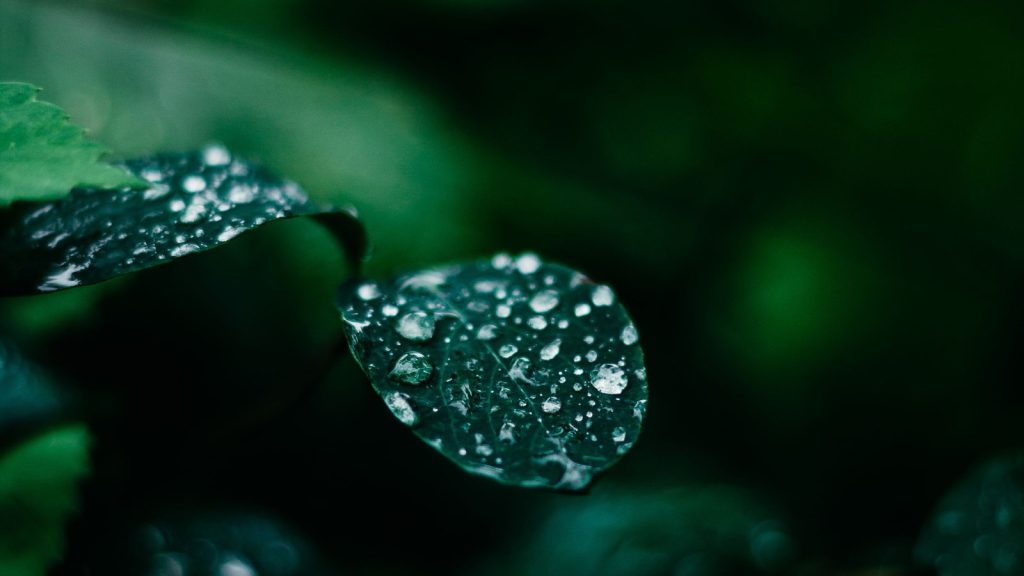
Water beads up because the molecules at its surface are pulled inward and sideways by their neighbors, with nothing above them pulling back. That imbalance creates a stretched, elastic layer called surface tension, which is strong enough to hold a droplet in a rounded shape, float a water strider, and let you pile water above the rim of a coin. It is not a skin, and nothing is pressing in from outside.
What surface tension actually is
Water molecules stick to each other through hydrogen bonds. Each molecule is slightly positive on its hydrogen side and slightly negative on its oxygen side, so it tugs on its neighbors and they tug back. Inside a drop, a molecule is pulled equally in every direction, and the forces cancel out.
A molecule at the surface is in a different situation. It has neighbors below and to the sides, but almost none above it, because the air does not pull on it the way water does. The net force on that molecule points inward, toward the rest of the liquid. The surface layer is therefore under tension, like a stretched sheet, and it tries to shrink to the smallest area it can. For a given volume, the smallest area is a sphere, which is why small droplets are round.
The strength of this effect is measured in millinewtons per meter. Pure water at room temperature has a surface tension of about 72 mN/m, which is high for a liquid, higher than alcohol or oil. That number is why water forms beads instead of spreading into a thin film, and why a needle or a paper clip can rest on the surface of a glass of water without sinking.
Why water beads on a leaf but spreads on glass
Whether a drop beads or spreads depends on a competition between two forces. Cohesion is water pulling on water. Adhesion is water pulling on the surface beneath it. When cohesion wins, the drop pulls itself into a ball and sits high. When adhesion wins, the drop spreads out to touch as much of the surface as it can.
The angle where the drop meets the surface is called the contact angle. On a waxy leaf or a freshly waxed car, the contact angle is large, well over 90 degrees, and the drop looks like a dome. On clean glass, the contact angle is small, and the water flattens into a thin layer. The lotus leaf takes this further with microscopic bumps and a waxy coating that trap air under the drop, so water barely touches the leaf at all. That is the lotus effect, and it is why some leaves stay dry after rain.
Why soap makes water spread
Soap molecules are built with two ends that behave differently. One end is attracted to water; the other is repelled by it and prefers oil and grease. When soap dissolves, its molecules crowd the surface of the water, with the water-loving ends in the water and the water-fearing ends sticking out into the air. This breaks up the tidy hydrogen-bond network at the surface and lowers the surface tension dramatically, from about 72 mN/m to roughly 30 mN/m for a typical soap solution.
Lower surface tension means water no longer pulls itself into tight beads. It spreads out, wets surfaces it would otherwise slide off, and can mix with grease. That is the whole basis of washing: the soap does not dissolve the dirt, it lowers the surface tension so water can reach the dirt and lift it away. The same effect is why soap bubbles can form at all, because a bubble is a thin film of water stabilized by soap molecules on both sides.
The coin experiment
Place a dry coin on a flat surface and add water one drop at a time from a dropper or a straw. The water will pile up above the rim of the coin in a dome, held by surface tension, and it will keep going well past the point where you expect it to spill. A typical coin holds somewhere around 20 to 30 drops, depending on its size, how clean it is, and how carefully you add each drop. The dome eventually collapses when the weight of the water exceeds what the surface layer can support.
Then repeat the experiment with a drop of soapy water added to the coin first. The dome collapses almost immediately, often after only a few drops, because the soap has lowered the surface tension that was holding it together. The difference between the two runs is a direct measurement of surface tension, and it takes about two minutes.
Where surface tension shows up in nature
Water striders are the clearest example. These insects are denser than water, but their legs are covered in tiny water-repelling hairs that spread their weight over a large area of surface. The surface layer dents but does not break, and the insect skates across it. If you add a drop of soap to the pond, the surface tension drops and the strider sinks, a demonstration that has been used in classrooms for decades.
Dew on a spiderweb is another version. Water condenses on the silk, and surface tension pulls it into evenly spaced droplets along the thread, because that shape minimizes the surface area for each volume. Capillary action, the way water climbs a narrow tube or moves up a plant stem, is a related effect: adhesion pulls water against the walls of the tube, and surface tension at the top pulls the column upward. Neither force alone is enough; it is the combination that lifts the water.
Two more things to try
Sprinkle black pepper on a bowl of water and touch the center with a soapy finger. The pepper shoots to the edges. The soap lowers the surface tension in the middle, and the higher tension at the rim pulls the surface outward, carrying the pepper with it. It looks like the pepper is running away from the soap, but the pepper is only showing you which way the surface is moving.
For a slower version, put a few drops of food coloring in a shallow dish of milk and touch the surface with a soapy cotton swab. The colors swirl as the soap disrupts the surface and the fat in the milk. Both experiments use the same principle as the coin: soap changes the balance of forces at the surface, and the visible motion is the result.
Surface tension is one of the few molecular properties you can see with your own eyes, without a microscope. A bead of water on a leaf, a dome on a coin, a strider on a pond: each one is a picture of molecules pulling on each other. For more on the particles involved, see what matter is; for the chemistry of how soap works, see how soap works; and for another case where molecular arrangement changes what a substance does, see why ice floats.