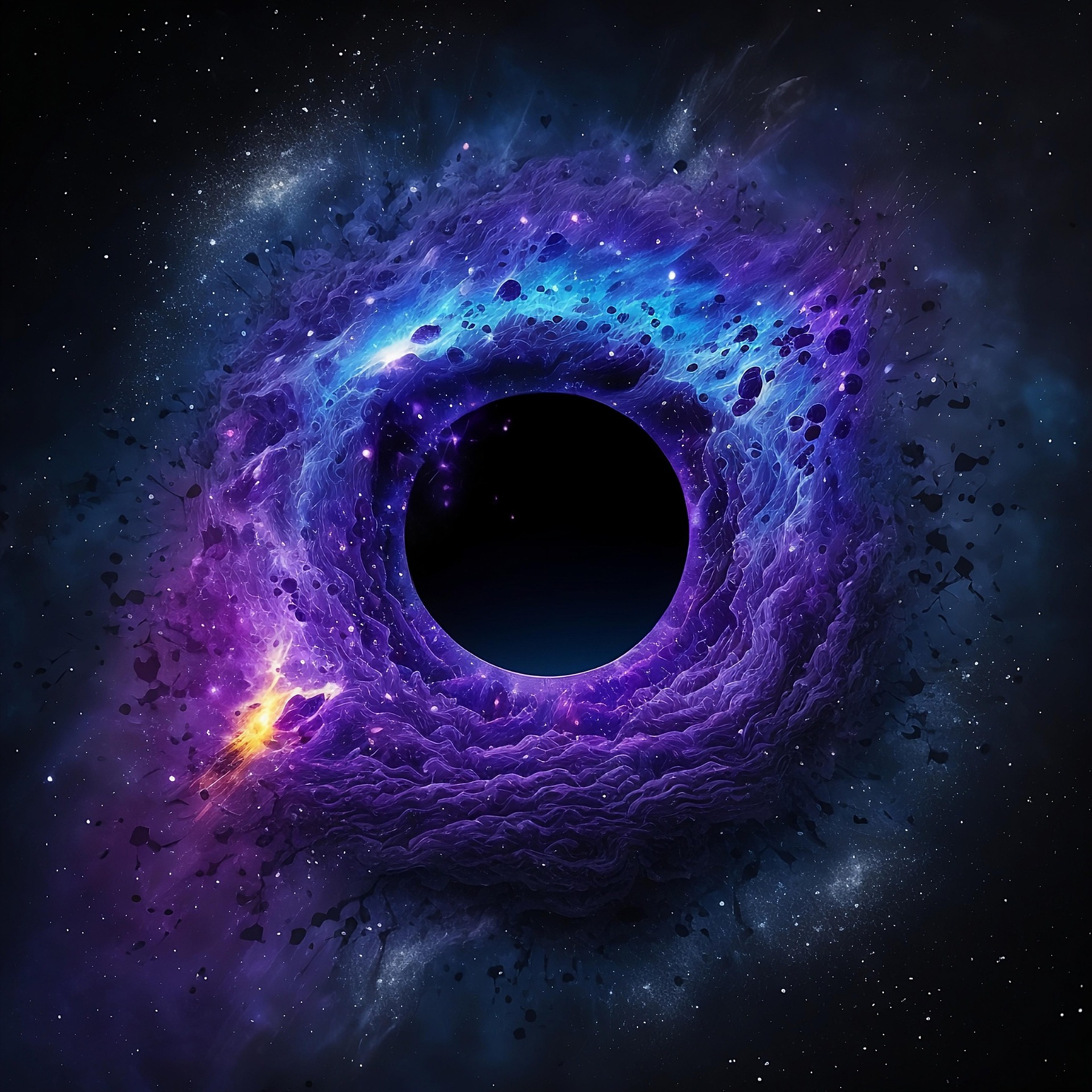
# What Is a Black Hole?
A black hole is a strange and powerful object in outer space. It has incredibly strong gravity. Once anything crosses its boundary called the event horizon, nothing can escape, not even light. Since light cannot get out, we cannot see the black hole directly, which gives it the name “black hole”.
## How Do Black Holes Form?
Most black holes come from huge stars. When a massive star uses up all its nuclear fuel, it can no longer fight against its own gravity. The star’s core collapses inward quickly, and the outer part of the star blows out in a bright supernova explosion. If the leftover core is heavy enough, it collapses into a black hole.
## What Is the Event Horizon?
The event horizon is the point of no return around a black hole. Before crossing this boundary, objects can still escape. Once past it, no speed in the universe, not even the speed of light, can break free from gravity. Time also changes dramatically near the event horizon.
## Different Kinds of Black Holes
### Stellar-mass Black Holes
This type forms from dead massive stars. Their mass ranges from a few times to dozens of times the mass of our Sun. They are spread throughout galaxies.
### Supermassive Black Holes
These giants sit at the center of nearly every galaxy, including our Milky Way. Their mass can be millions or billions of times heavier than the Sun. Scientists believe they grow slowly by swallowing gas, dust and merging with other black holes.
## Popular Myths About Black Holes
Many people think black holes “suck” everything in the universe. This is not true. If our Sun were replaced by a black hole of the same mass, Earth would keep orbiting safely. Only objects that travel very close to the event horizon get trapped.
Black holes are not cosmic vacuum cleaners. Distant planets and stars stay safe.
## How Scientists Find Black Holes
Since black holes produce no light, telescopes cannot photograph them directly. Scientists discover black holes by observing their gravity’s influence. A black hole will pull nearby gas and stars, making the gas heat up and glow brightly. Astronomers track this glowing material to spot hidden black holes.
## Conclusion
Black holes are one of the most surprising discoveries in astronomy. They test our understanding of gravity, space and time. Scientists keep observing and researching them to unlock more secrets of our universe.
🔬 Tools We Recommend
Loved this article? Here are the hands-on kits and learning tools we actually use — tested by real families, and the ones our own kids keep reaching for.
ScienceBases is reader-supported. When you buy through links on this page, we may earn a commission — at no extra cost to you. Full disclosure.