# Rainbows: How Sunlight Paints Colorful Arcs in the Sky
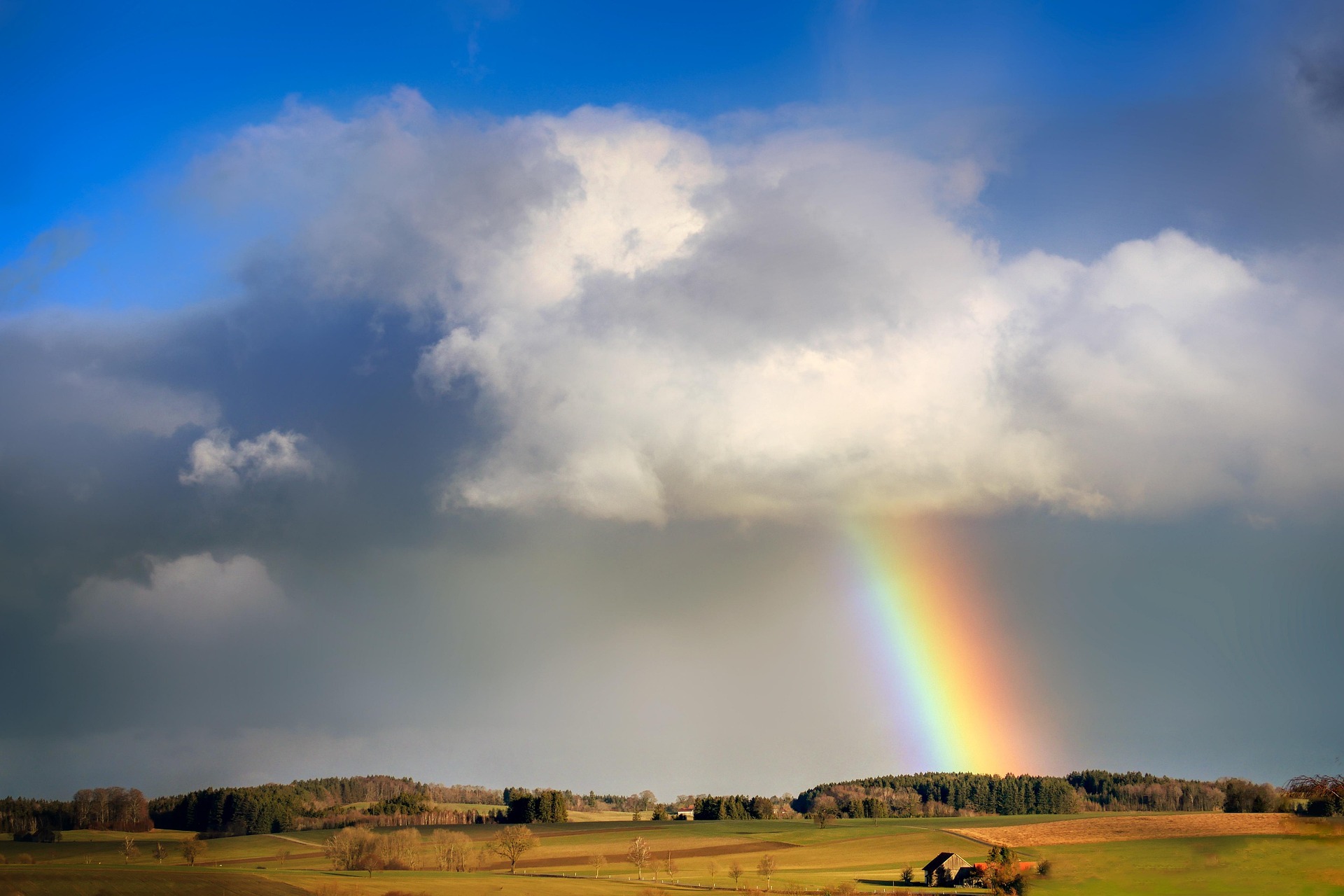
A rainbow is one of the most beautiful sights in nature. When sunlight breaks into bright bands of red, orange, yellow, green, blue, indigo and violet, it forms a glowing curved arc across the sky. Many people think rainbows are physical objects, but they are actually optical illusions created by light and water drops.
How Rainbows Form
Rainbows need two simple ingredients: sunlight and falling raindrops. When sunlight hits a round raindrop, the light bends. This bending effect is called refraction. White sunlight is a mix of all visible colors, and each color bends at a slightly different angle.
The separated colors reflect off the back inner surface of the water drop. Then the light refracts again as it exits the drop. This splits white light into the full spectrum of colors we see in a rainbow.
Why the Classic Color Order
Red sits on the outer edge of the rainbow arc, while violet appears on the inner edge. This fixed order comes from different refraction angles. Red light bends the least, and violet light bends the most.
Double rainbows sometimes appear above the main bow. In a secondary rainbow, the color sequence reverses, with violet on the outside and red on the inside. This happens when light bounces twice inside one raindrop.
The Best Time to See a Rainbow
You can only see rainbows when the Sun is low behind your back and rain is falling in front of you. The sun angle has to be less than 42 degrees above the horizon. That means rainbows most often show up in early morning or late afternoon after brief showers.
Rainbows do not stay in one spot. They depend on your viewpoint. If you move, the rainbow you see also shifts. No two people see exactly the same rainbow.
Common Misconception
A rainbow is not located at a fixed distance away from you. It is not a solid arch touching the ground. It is a light effect made from countless separate raindrops. You can never reach the “end of the rainbow”, no matter how far you walk toward it.
Conclusion
Rainbows are a wonderful example of light physics in daily life. They turn ordinary sunlight and rain into a colorful show. Understanding how rainbows form helps us see the hidden rules of light all around our world.
🔬 Tools We Recommend
Loved this article? Here are the hands-on kits and learning tools we actually use — tested by real families, and the ones our own kids keep reaching for.
ScienceBases is reader-supported. When you buy through links on this page, we may earn a commission — at no extra cost to you. Full disclosure.