You cannot stretch a tape measure to a star. You cannot even send a laser pulse and wait, because the light would take years to come back and would be far too faint to detect. So astronomers do something cleverer: they use a chain of methods, each one calibrated by the one before it, extending outward step by step.
The Short Answer
How do we measure distance in space? With a ladder. Radar measures the inner solar system directly. Parallax measures nearby stars by watching them shift against the background as Earth orbits the Sun. Standard candles — objects of known brightness — extend the ladder to other galaxies. Redshift takes over at the largest scales.
Each rung only works within a certain range, and each is calibrated using the rung below it. The whole structure is self-consistent, which is why astronomers trust it.
Rung 1: Radar
For objects within the solar system, we just time a signal. Bounce a radar pulse off Venus or a near-Earth asteroid, measure the round trip, multiply by the speed of light. This gives the astronomical unit to within a few meters.
The AU is the foundation of everything else. Once you know it precisely, Kepler’s laws give you the distances to all the planets, because their orbital periods are known to high precision.
Rung 2: Parallax
Hold a finger in front of your face and alternate eyes. The finger jumps against the background. That is parallax, and astronomers do the same thing with Earth’s orbit as the two “eyes.”
Measure a star’s position in January, then again in July, and the star shifts against distant background objects. The shift is tiny — under one arcsecond even for the nearest stars — but measurable. One arcsecond of shift at a baseline of 1 AU corresponds to a distance of 1 parsec, which is 3.26 light-years.
The Gaia satellite has pushed this technique to extraordinary precision, measuring parallaxes of about 20 microarcseconds for bright stars. That covers objects out to roughly 30,000 light-years.
Rung 3: Standard Candles
Beyond parallax, we need objects whose true brightness we can infer. If you know how bright something actually is, and you measure how bright it appears, you can calculate the distance — because brightness falls off with the square of distance.
- Cepheid variables — pulsating stars whose period is tightly linked to their luminosity. Hubble used them in 1923 to prove Andromeda was outside the Milky Way.
- Type Ia supernovae — white dwarfs that explode at a consistent peak brightness. Visible across billions of light-years.
- Tip of the red giant branch — a sharp cutoff in a galaxy’s brightness profile that marks a known luminosity.
Rung 4: Redshift
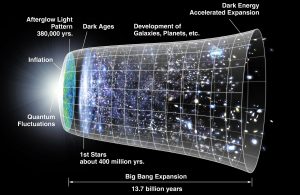
At the largest distances, we use the expansion of the universe itself. Light from a receding galaxy is stretched to longer wavelengths, and the amount of stretch tells us how much space has expanded since the light left. Hubble’s law converts that into distance.
This only works because the expansion is smooth on large scales. For nearby galaxies, peculiar motion from local gravity can dominate, which is why redshift is unreliable inside about 100 megaparsecs.
The Units, and When to Use Them
| Unit | Equals | Used for |
|---|---|---|
| Astronomical unit (AU) | 93 million miles | Solar system |
| Light-year | 5.88 trillion miles | Stars and nearby galaxies |
| Parsec (pc) | 3.26 light-years | Professional astronomy |
| Kiloparsec (kpc) | 3,260 light-years | Galaxy structure |
| Megaparsec (Mpc) | 3.26 million light-years | Galaxy clusters |
The mix of units is a historical accident, not a design. Astronomers keep all of them because each is convenient at its own scale, the same way you use inches for a book and miles for a road trip.
Why the Ladder Holds Together
The rungs overlap. Parallax works out to a few thousand light-years; Cepheids are visible in galaxies millions of light-years away; Type Ia supernovae reach billions. Each overlap lets astronomers check one method against another.
That checking has caught real errors. In the 1990s, Hipparcos satellite data suggested the Pleiades cluster was closer than ground-based measurements said. The discrepancy took years to resolve and turned out to be a systematic error in the satellite’s parallax calibration. Every rung depends on the one below it, which is why any answer to how do we measure distance in space comes in layers rather than as one number.
The Tension at the Top
There is currently a genuine disagreement in cosmology. Measurements of the expansion rate from the nearby ladder give about 73 km/s per megaparsec. Measurements from the cosmic microwave background, extrapolated forward with our standard model, give about 67. The error bars do not overlap.
Either one measurement is wrong, or the standard model is missing something. This is called the Hubble tension, and it is one of the most active problems in physics. The distance ladder is at the center of it.
Keep Exploring
- What is a light-year? — the unit most people misread
- What is the Milky Way? — the galaxy these methods mapped
- What is dark energy? — why redshift distances keep growing