Every planet you have ever seen in a photograph started as a grain of dust smaller than a smoke particle. The process that turned that grain into Jupiter took less than 10 million years, which is fast — the Sun will live for 10 billion.
The One-Paragraph Version
A cloud of cold gas collapses. It flattens into a disk because rotation and conservation of angular momentum prevent it from falling straight in. Dust grains in the disk stick together, grow into pebbles, then into kilometer-wide rocks, then into planetary embryos. Some embryos gather gas; others stay rocky. When the gas clears, the survivors are planets.
That is genuinely how do planets form, and the hard part is not the outline — it is the details, which took astronomers decades to work out.
Step 1: The Collapsing Cloud
Molecular clouds are cold, about 10 K, and mostly hydrogen. A shock wave from a nearby supernova or a collision with another cloud can push a region past the density where gravity wins. The core collapses in a few hundred thousand years, spinning faster as it shrinks, like an ice skater pulling in her arms.
Conservation of angular momentum guarantees a disk. Material falling straight down the rotation axis lands on the star; material with sideways motion settles into orbit. The result is a protostar wrapped in a protoplanetary disk of gas and dust, typically 100 AU across.
Step 2: Dust to Pebbles
Microscopic grains collide gently and stick through electrostatic forces, the same effect that makes packing peanuts cling to your hand. They build up to millimeter sizes easily. Then comes the meter-size barrier.
Objects about a meter across are in trouble. They are big enough that collisions shatter them instead of sticking, and small enough that drag from the gas makes them spiral into the star within a few thousand years. This “meter-size barrier” was a serious problem for planet formation theory for years.
The leading fix is that clumps form directly. Pebbles concentrate in high-pressure regions of the disk, collapse under their own gravity, and skip straight to 100-km planetesimals. Observations of the Kuiper Belt support this — it contains many binary objects that look like they formed from collapsing pebble clouds rather than slow accretion.
Step 3: Runaway Growth
Once you have 100-km bodies, gravity takes over. A planetesimal’s gravitational pull focuses the trajectories of nearby smaller objects, increasing its collision cross-section. Growth accelerates: bigger gets bigger faster.
| Stage | Size | Time from start |
|---|---|---|
| Dust grain | Micrometers | 0 years |
| Pebble | Millimeters | ~10,000 years |
| Planetesimal | 1 to 100 km | ~100,000 years |
| Embryo | 1,000 km | ~1 million years |
| Planet | 3,000 to 140,000 km | ~10 million years |
Step 4: The Frost Line Decides the Winner
Inside about 3 AU, water is vapor. Outside, it is ice, and ice is everywhere. A planetesimal beyond the frost line has roughly twice the solid material to work with, and it holds onto it because ice is sticky.
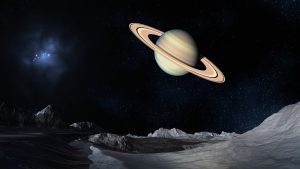
Jupiter’s core probably reached 10 Earth masses in under a million years. At that point its gravity could capture hydrogen and helium directly from the disk, and it ballooned to 318 Earth masses. Saturn did the same but ran out of gas sooner. Uranus and Neptune likely formed closer in and migrated outward, which explains why they are smaller and why their orbits are oddly tilted.
Step 5: Clearing the Disk
The young Sun blasted the remaining gas away with ultraviolet radiation and a strong solar wind within about 10 million years. Any planet that had not grabbed an atmosphere by then never would. This is why Mars is a rock with a thin skin of air and Jupiter is a ball of the same hydrogen the Sun is made of.
The leftover planetesimals became asteroids and comets. The ones that hit Earth delivered water and carbon compounds, which is one reason our planet has oceans and the Moon does not.
Why the Solar System Looks Tidy
Early orbits were chaotic. Embryos crossed paths, collided, and scattered each other. Earth’s Moon probably formed when a Mars-sized body hit Earth and threw debris into orbit. Uranus is tipped 98 degrees, almost certainly from a giant impact. What you see today is the surviving configuration after a few hundred million years of gravitational billiards.
We now have direct images of other systems mid-formation — rings and gaps in disks around stars like HL Tauri and PDS 70 — and they match the model remarkably well. The process is not unique to us. It is happening right now, in thousands of nearby star systems. None of that changes the basic answer to how do planets form: dust gathers, gravity amplifies, and the disk decides what kind of world you get.
Keep Exploring
- What is the solar system? — the finished product, region by region
- What is a dwarf planet? — the embryos that never finished
- What is a supernova? — the explosion that seeds the next cloud