
Put almost any liquid in a freezer and the solid version sinks in the liquid version. Solid nitrogen sinks. Solid wax sinks in liquid wax. It’s the normal pattern — molecules pack tighter as they cool, things get denser, denser things sink.
Water refuses. And why does ice float is one of those questions where the answer turns out to matter enormously, because if ice sank, winter would kill almost everything living in a lake.
Density: The Short Version
Density is mass packed into a space. Same mass, more space = less dense = floats. So “ice floats” is really saying “ice takes up more room than the water it came from.”
That’s backwards from normal. Freezing something usually means its molecules huddle closer together. Water expands by about 9% when it freezes, which is why a full bottle in the freezer cracks.
What Water Molecules Do When They Get Cold
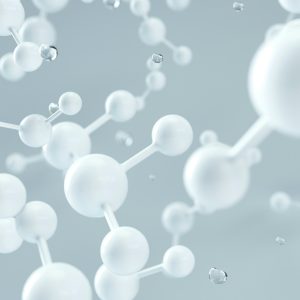
A water molecule is one oxygen and two hydrogens — H₂O. Oxygen hogs electrons, so it ends up slightly negative and the hydrogens end up slightly positive.
Opposite charges attract, so the positive hydrogen on one molecule reaches toward the negative oxygen on its neighbour. That’s a hydrogen bond, and it’s weak — maybe 5% as strong as the bonds holding the molecule itself together. Weak, but bossy.
In liquid water, molecules are hot enough to keep moving, so hydrogen bonds form and break constantly. Molecules tumble past each other and pack fairly tightly.
Cool it down and they slow. Around 4°C, something specific happens: the hydrogen bonds stop breaking as fast as they form, and they start forcing the molecules into a fixed arrangement — a hexagonal lattice, with each oxygen holding four hydrogens at a set distance.
That lattice has gaps. Big ones. The molecules end up further apart than they were in the liquid, and locked there.
| Liquid water (4°C) | Ice (0°C) | |
|---|---|---|
| Molecular arrangement | Loose, constantly shifting | Fixed hexagonal lattice |
| Hydrogen bonds | Form and break constantly | Stable, holding shape |
| Space between molecules | Tight | Open, with gaps |
| Density | ~1.00 g/cm³ | ~0.92 g/cm³ |
| Result | — | Floats |
Why This Saves Every Fish in the Lake
Think about what happens if ice sank — the normal behaviour for basically every other substance.
Ice forms at the surface, sinks to the bottom, and more ice forms and sinks on top of it. The lake freezes from the bottom up. By midwinter it’s a solid block. Nothing survives that.
Because ice floats, the opposite happens. A layer forms on top and then insulates everything below it — ice is a poor conductor of heat. The surface hits -20°C while the water at the bottom sits comfortably at 4°C, which is where water is densest and why that temperature specifically collects at the bottom.
Fish spend the winter in that 4°C layer. It’s not warm, but it’s liquid, and liquid is the only requirement.
Also Why Potholes Exist
Same chemistry, much less charming. Water seeps into a crack, freezes, expands 9%, and pries the crack wider. Repeat across a winter and you have a pothole.
It’s also why you shouldn’t put glass bottles full of liquid in the freezer, and why pipes burst in unheated houses. That 9% is a genuinely large amount of force.
One More Thing: It’s Not Just Ice
Water’s weirdness doesn’t stop at freezing. It also has unusually high surface tension (bugs walk on it), an unusually high boiling point for such a small molecule, and it dissolves more substances than almost anything else — which is precisely why it’s the solvent life runs on.
All of it traces back to the same source: that slightly-negative oxygen and those slightly-positive hydrogens, reaching for each other.
Keep Going
- Water’s role in biology: how photosynthesis works.
- Or see what happens when light hits water in the air: how rainbows form.


3 thoughts on “Why Does Ice Float? The Chemistry Quirk That Keeps Fish Alive”