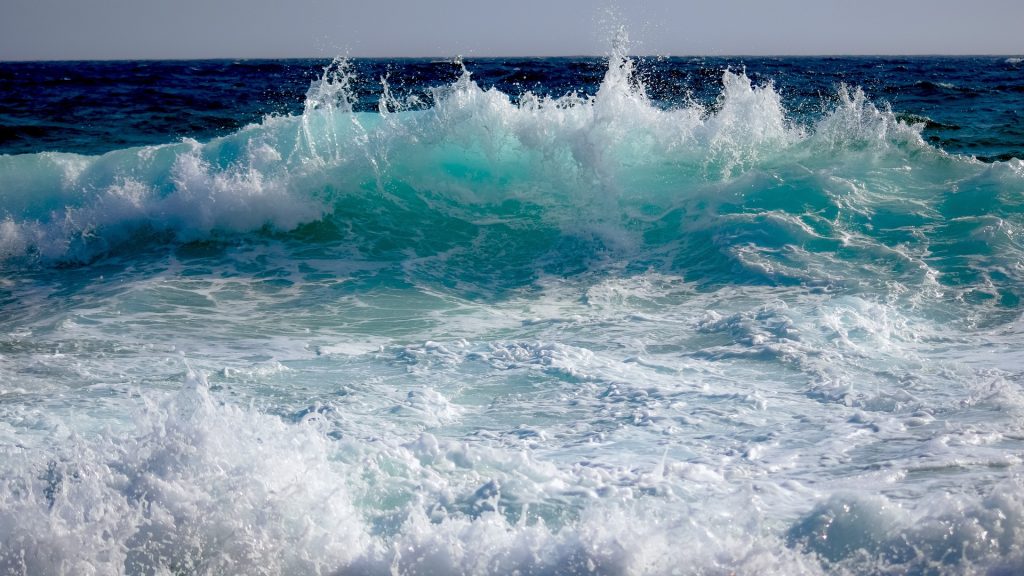
What is the water cycle? It is the continuous movement of water between the ocean, the atmosphere, the land, and back — driven by solar energy and gravity, with no beginning and no end. The total amount of water on Earth has been essentially fixed for billions of years. What changes is where it is and what state it is in.
The Four Main Steps
| Step | What happens | Driven by |
|---|---|---|
| Evaporation | Liquid water becomes vapor | Solar energy |
| Transpiration | Plants release vapor through leaves | Solar energy + plant biology |
| Condensation | Vapor cools and forms droplets | Cooling with altitude |
| Precipitation | Water falls as rain, snow, sleet, or hail | Gravity |
| Collection / runoff | Water gathers and flows back to the ocean | Gravity |
Evaporation and transpiration are often combined as evapotranspiration, because from the atmosphere’s point of view they are the same input. Plants move a genuinely large amount of water: a single large oak can transpire hundreds of liters on a hot day.
Where Water Sits, and For How Long
This is the part that reframes everything — how long water typically stays put before moving on:
| Reservoir | Share of Earth’s water | Average residence time |
|---|---|---|
| Oceans | ~97% | ~3,000 years |
| Glaciers and ice caps | ~2% | Up to 10,000+ years |
| Groundwater | ~0.7% | Days to 10,000 years |
| Lakes and rivers | ~0.01% | Days to decades |
| Atmosphere | ~0.001% | About 9 days |
The atmosphere holds almost nothing and cycles it incredibly fast. Water vapor turns over roughly every nine days, which is why weather is so changeable while the ocean is not.
Freshwater is about 2.5% of all water, and roughly 70% of that is locked in ice, mostly in Antarctica and Greenland. Of the liquid freshwater that remains, the overwhelming majority is groundwater — surface lakes and rivers are a rounding error.
Why It Rains Where It Rains
Air holds more water vapor when it is warm — roughly 7% more per degree Celsius. So the way to get rain is to cool a moist air mass, and there are three main ways nature does it:
- Orographic — air is forced up over mountains, cools, and drops rain on the windward side. The leeward side is dry, which is how rain shadows and deserts form.
- Convectional — the sun heats the ground, air rises, cools, and produces afternoon thunderstorms. Standard in the tropics and in summer elsewhere.
- Frontal — a warm air mass meets a cold one; the warm, lighter air is forced up over it. This is the classic mid-latitude weather system.
How Water Gets Underground
So what is the water cycle actually shifting? Roughly half a million cubic kilometers of water every year.
Some precipitation infiltrates into soil and percolates down until it hits an impermeable layer, filling the pore spaces above it. That saturated zone is an aquifer, and the top of it is the water table.
Aquifers supply a large share of the world’s drinking water and most irrigation. The problem is recharge rate. Some aquifers refill in years; others — the so-called fossil aquifers, like the Ogallala in the US and the Nubian Sandstone beneath North Africa — accumulated over thousands of years and are effectively non-renewable on human timescales.
Pumping those is mining water, not harvesting it. The Ogallala has declined significantly since large-scale irrigation began in the 1950s.
How Warming Changes the Cycle
A warmer atmosphere holds more moisture, and a warmer atmosphere also evaporates water faster. Both effects push the same direction: the cycle intensifies.
The pattern that follows is not uniform wetness. It is wet regions getting wetter and dry regions getting drier, because the circulation shifts as well as the moisture content. Heavy precipitation events intensify faster than average rainfall — the largest storms get heavier — while dry areas experience longer gaps between events and faster soil drying.
This is why “more rain overall” and “more drought” are not contradictory statements. They are the same change viewed from two different places.
The Water You Drank Already Circulated
The water in your glass today has very likely been ocean water, rain, river water, glacier ice, groundwater, and vapor inside a plant — possibly several times over. There is essentially no new water being added to the planet, and very little escaping to space.
What that means practically: water is not consumed so much as borrowed and, often, dirtied. Treatment and reuse are the actual levers, not supply.
Keep Exploring
- How do clouds form? — the visible part of the cycle
- Weather vs climate — days versus decades
- Why is the ocean salty? — what runoff carries along

2 thoughts on “What Is the Water Cycle? Where Every Drop Has Been”