—
There are two high tides a day because the tide is not caused by the Moon pulling water toward it. It is caused by the difference in the Moon’s pull on the near side of Earth and the far side. That difference stretches the oceans into two bulges, one facing the Moon and one facing away, and Earth rotates through both of them roughly every 24 hours and 50 minutes.
The explanation most people hear is wrong
The usual picture is that the Moon’s gravity lifts the ocean on the side facing it, like a magnet pulling on iron filings. That explains one bulge. It does not explain the second one on the opposite side of the planet, and it implies that the Moon’s pull is strong enough to overcome Earth’s gravity, which it is not. The Moon’s gravity at Earth’s surface is roughly one part in 300,000 of Earth’s own gravity. It cannot lift an ocean.
What the Moon can do is pull slightly harder on the water nearest to it than on the water farthest from it. That difference, not the pull itself, is what moves water around. Physicists call it a tidal force, and it is a gradient effect.
Why distance matters so much
Gravity weakens with distance, and the tidal force depends on how fast it weakens across the width of the body being pulled. For gravity, the force falls off with the square of distance. For the tidal force, the difference between the pull on the near side and the pull on the far side, it falls off with the cube of distance. That is why the Moon, which is much smaller than the Sun but much closer, dominates the tides. The Sun’s tidal force is about 46 percent as strong as the Moon’s, even though the Sun’s total gravity on Earth is far greater.
Across Earth’s diameter of about 12,700 kilometers, the Moon’s pull on the near side is measurably stronger than on the far side. Water, being fluid, responds to that difference by flowing toward the near side and away from the far side, producing a bulge on each end.
Two bulges, and why the far one exists
The near-side bulge is the easy one. The Moon pulls the near water slightly more than it pulls Earth’s center, so that water lags behind the solid Earth and piles up toward the Moon.
The far-side bulge is the one that confuses people. The Moon pulls the far water slightly less than it pulls Earth’s center, so the solid Earth accelerates toward the Moon a little faster than the far ocean does. In effect, the far ocean is left behind, and it bulges away from the Moon. The two bulges are not two separate pulls; they are the two ends of one stretching effect.
There is a second way to describe the same thing. Earth and the Moon orbit a common center of mass, which lies about 4,700 kilometers from Earth’s center, still inside Earth. As Earth swings around that point each month, every part of the planet traces a small circle. The centrifugal effect is slightly stronger on the far side, and that adds to the stretching. Both descriptions give the same two bulges; the gradient picture is the more fundamental one.
Why high tide is later every day
If Earth rotated once every 24 hours relative to the Moon, high tides would come exactly 12 hours apart. But the Moon is also moving in its orbit, traveling about 13 degrees eastward each day. Earth has to rotate a little further to bring the same point back under the Moon, and that extra rotation takes about 50 minutes. The result is a lunar day of about 24 hours and 50 minutes, and high tides spaced about 12 hours and 25 minutes apart.
This is why a tide table shifts by roughly 50 minutes each day, and why a high tide at noon on Monday becomes a high tide around 12:50 on Tuesday. It is also why the two daily high tides rarely fall at convenient times.
Spring tides and neap tides
The Sun also produces a tidal force, and it lines up with the Moon’s twice a month. At new moon and full moon, the Sun, Earth, and Moon are nearly in a line, and the two tidal forces add together. The result is a spring tide, with higher high tides and lower low tides than usual. At first quarter and third quarter, the Sun and Moon pull at right angles, and their effects partly cancel. The result is a neap tide, with a smaller range.
The names have nothing to do with the season. Spring tides happen twice a month, all year, and they are the clearest times to see an extreme low tide at a rocky shore.
Why real tides are messy
If Earth were covered by a uniform ocean with no continents, the two-bulge model would predict the tides almost exactly. Real oceans are not uniform. Continents block the flow, seafloor depth varies, and each ocean basin has its own natural rocking period. When the tidal forcing matches that period, the basin resonates and the tide can be amplified. The Bay of Fundy, between New Brunswick and Nova Scotia, has tides that range over 15 meters because of resonance and its funnel shape.
In some places the geometry produces one high tide a day instead of two, a pattern called a diurnal tide. In others the two daily highs are unequal, which is called a mixed tide. Local tide tables are built from decades of measurements at each harbor, not from the two-bulge model alone. The model explains why there are two bulges; the tables tell you when the water actually arrives.
What to look for at the shore
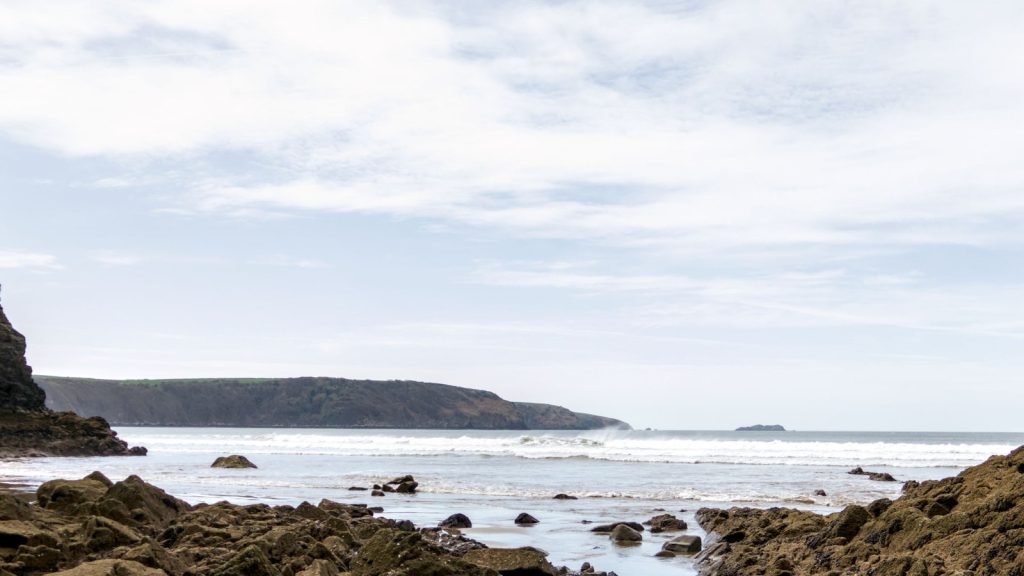
The simplest observation is to pick a fixed rock or post at the waterline and check it every hour for a day. The water will rise, pause, fall, and rise again, and the pattern will repeat about 50 minutes later the next day. If you are near a rocky coast at a spring low tide, the exposed zone can be dramatically wider than at a neap tide: the same shore, two very different worlds.
For the phases that drive spring and neap tides, see why the Moon changes shape. For how water moves around the planet more broadly, see how ocean currents work.