You do not need a burner, a fume hood, or a $600 kit. Homeschool science without a lab covers most of what a standard middle-school course asks for, provided you stop trying to replicate school equipment and start using what a kitchen already does well: measuring, heating, mixing, and observing over time.
What a Lab Actually Provides
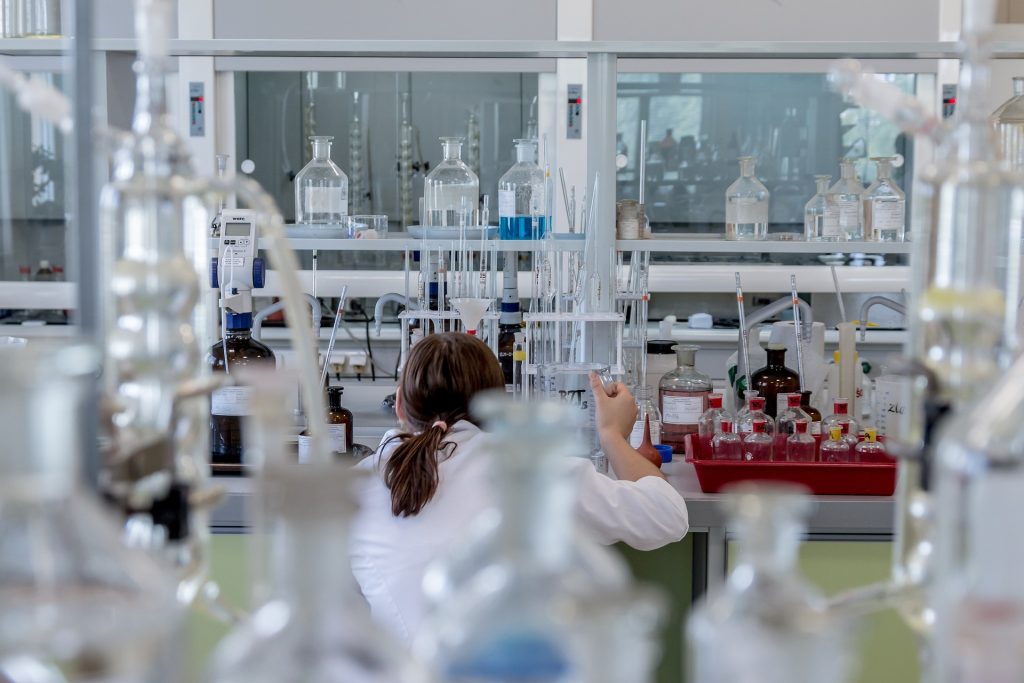
A school lab does four things: it measures precisely, applies controlled heat, contains mess and hazard, and stores equipment between sessions. Reproduce those four functions at home and almost nothing else matters. Precision comes from a scale and a thermometer; heat comes from a hob or a hot water bath; containment comes from a baking tray.
That reframing is the whole trick. Schools buy equipment because thirty children need the same apparatus at the same time, not because the science demands it. At home with one or two students, a measuring jug and a tray cover the same ground.
The Substitute Kit
| Lab item | Home substitute | Typical cost |
|---|---|---|
| Beakers | Glass jars and Pyrex measuring jugs | $0 |
| Test tubes | Clear plastic cups on a tray | $0 |
| Bunsen burner | Hob, or a bowl of hot water | $0 |
| Scale, 0.1 g | Digital kitchen scale | $15 |
| Thermometer | Digital cooking thermometer | $12 |
| Measuring cylinder | Kitchen measuring jug | $6 |
| Safety glasses | Any certified pair | $8 |
| Microscope | Borrow first, buy at grade 7+ | $0-$120 |
That is under $45 for the items you do not already own. Spend the rest on consumables you will actually use up.
Ten Lab Skills You Can Teach at Home
These are the skills a lab course is meant to build, and every one of them is teachable on a kitchen counter. Homeschool science without a lab still covers all ten.
| Skill | Home activity that teaches it |
|---|---|
| Measuring mass | Weigh dry ingredients before and after a reaction |
| Measuring volume | Displacement method with an irregular object |
| Controlling variables | Seed trays with one difference only |
| Using a control | One plant in the dark, one in light |
| Repeating trials | Three runs of the same ramp, averaged |
| Recording data | A dated table with units in the header |
| Graphing | Height versus day for a seedling |
| Using a hypothesis | “If I warm the vinegar, then…” |
| Observation over time | Crystal growth photographed daily |
| Writing a conclusion | One paragraph: claim, evidence, reason |
Setting Up a Safe Work Zone
- One surface that is cleared, wipeable, and near a sink
- A baking tray under anything wet, coloured, or fizzing
- Safety glasses in the same drawer every time, so the habit forms
- A rule that nothing used in an experiment is tasted, ever
- Vinegar and any heating step require an adult present
What Genuinely Needs Real Equipment
Three things are hard to fake: magnification below about 1 mm, quantitative chemistry with real reagents, and anything electrical beyond a battery. Borrow a microscope before grade 7. Buy a chemistry set with real glassware around grade 8 if your child is heading toward a lab credit. Everything else can wait.
Counting Lab Hours at Home
Log prep, run, and write-up separately. A 20-minute experiment with a proper write-up is easily a 50-minute lab session, and that is the honest number to record. Fifteen to twenty of those across a year, with reports on file, is a defensible lab course.
Keep one sheet per subject with three columns: date, minutes, and what was done. Total it monthly. That single sheet is what turns a year of scattered activities into a number you can defend if anyone asks.
A Week Without a Lab
| Day | Activity | Minutes |
|---|---|---|
| Monday | Read and define the question | 25 |
| Wednesday | Run the experiment, record data | 40 |
| Friday | Graph, write the conclusion | 35 |
Keep Exploring
- 15 science experiments at home — kitchen-supply starting point
- Biology experiments at home — no lab required
- How to record homeschool science credits — logging the hours