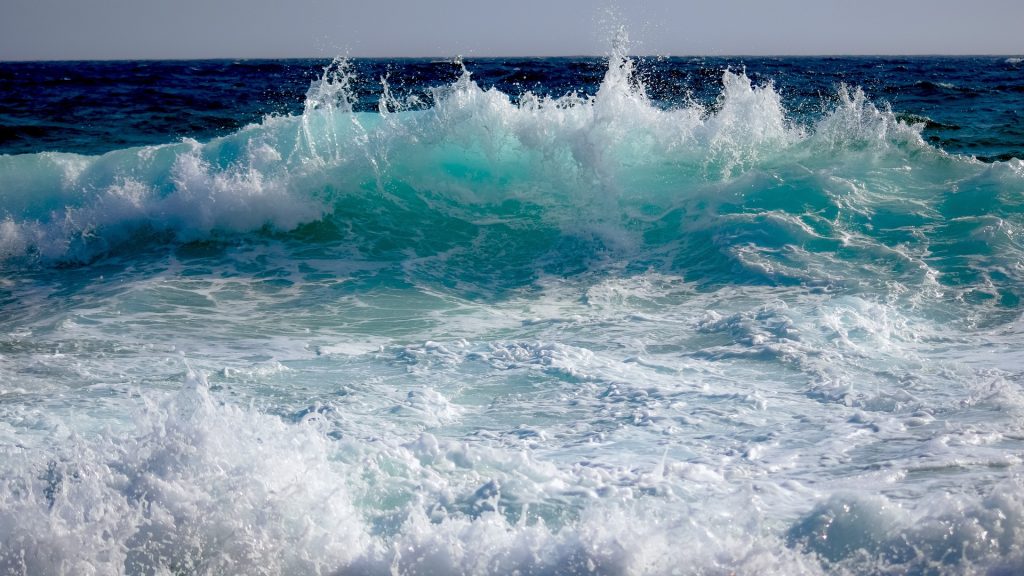
Why is the ocean salty? Because water flows toward the ocean carrying dissolved minerals, and the only way out is evaporation — which leaves the minerals behind. Over hundreds of millions of years, that one-way process has concentrated a great deal of salt. Rivers, by contrast, are constantly refreshed by rain and snow, so they never get the chance to accumulate.
Where the Ions Come From
Rainwater is very slightly acidic because dissolved CO2 forms weak carbonic acid. That mildly acidic water falls on rock and slowly dissolves it, releasing ions:
- Sodium and chloride — from weathering rocks and from hydrothermal vents on the seafloor
- Magnesium and calcium — from silicate and carbonate minerals
- Sulfate, potassium, bicarbonate — from rocks and from volcanic gases
Rivers carry all of this to the sea. Seawater is about 3.5% dissolved salt by weight — roughly 35 grams per liter, or about a teaspoon of salt in a cup of ocean water.
Why It Does Not Just Keep Getting Saltier
If rivers delivered salt continuously and nothing removed it, the ocean should be far saltier than it is. Something must take salt out, and several processes do:
- Hydrothermal vents — seawater circulates through hot new crust at mid-ocean ridges. Magnesium and sulfate are stripped out; calcium and other ions are added back.
- Biological removal — organisms build shells and skeletons from calcium carbonate and silica. When they die, much of that settles and becomes sediment.
- Evaporite deposits — in restricted basins where evaporation outpaces inflow, salt precipitates out and gets buried.
- Clay formation — certain reactions on the seafloor incorporate ions into new minerals.
The ocean is in a rough steady state: input from rivers and vents roughly balanced by removal. Its salinity has been broadly stable for very long stretches — it is not on a one-way climb.
Why Different Seas Have Different Salinity
So why is the ocean salty while a mountain stream is not? Time, and an exit route that only lets water leave.
| Body of water | Salinity | Why |
|---|---|---|
| Open ocean (average) | ~35 g/L | Baseline |
| Baltic Sea | ~7 g/L | Huge river input, little exchange with the ocean |
| Red Sea | ~40 g/L | High evaporation, narrow connection to ocean |
| Dead Sea | ~340 g/L | No outlet at all; everything evaporates |
| Mediterranean | ~38 g/L | Evaporation exceeds river and rain input |
The pattern is simple: salinity reflects the balance between freshwater coming in and water evaporating out. Enclosed seas in hot, dry climates concentrate; seas fed by big rivers in wet climates dilute.
The Dead Sea is the extreme — no outflow whatsoever, so every ion delivered over millennia is still there. It is roughly ten times ocean salinity, dense enough that you float without trying.
Why Sea Ice Is Fresh
When seawater freezes, the crystal structure excludes most of the salt. Fresh ice forms and the rejected salt concentrates in the brine pockets around it, most of which drains out over time.
This matters enormously for ocean circulation. Rejecting salt into the water below makes that water denser, and dense water sinks. That sinking is a major driver of the deep-ocean conveyor — so freezing sea ice near the poles helps drive currents that reach the tropics.
Saltiness Is Also a Climate Record
Salinity patterns tell us about the water cycle. Where evaporation is intense, the surface ocean gets saltier; where rainfall and river runoff dominate, it gets fresher. Measuring salinity over time therefore tracks changes in evaporation and precipitation.
Observed trends show a recognizable pattern: already-salty subtropical regions getting saltier, and high-latitude and tropical-rainfall regions getting fresher. That is consistent with an intensified water cycle, which is what warming predicts — wet places get wetter, dry places drier.
There is also a large-scale circulation concern. The Atlantic overturning depends on cold, salty water sinking in the North Atlantic. Add enough fresh meltwater and that water becomes too buoyant to sink. Most research indicates the circulation has slowed somewhat, though a complete shutdown is considered unlikely this century.
Keep Exploring
- How do ocean currents work? — what that salinity is actually driving
- How do fish breathe? — living in salty water
- What is the water cycle? — the delivery system for all those ions



1 thought on “Why Is the Ocean Salty? Where All That Salt Came From”