A simulation is not a cheaper experiment. It is a different tool that happens to look like the same thing, and the difference decides whether your child learns the physics or learns to click.
The question worth asking is not "are simulations good?" They are, in specific circumstances, better than physical equipment. The question is: which variables can software control that you cannot control in a kitchen, and which parts of doing science does software delete entirely?
Answer those two questions honestly and the split becomes obvious.
The test: what can you not build at home?
Physics experiments fail at home for a small number of reasons. Each one corresponds to a genuine capability of simulation.
Reason 1: You cannot remove friction
Roll a ball across a table and it slows down and stops. That is not the physics of a rolling ball — that is friction plus air resistance plus a table that is not level. If you are trying to teach that an object in motion stays in motion, the demonstration contradicts you.
A simulation sets friction to zero with one slider. The ball rolls forever, and the relationship between force and acceleration becomes visible rather than buried under a deceleration term.
This matters more than it sounds. Newton's first law is the one that students consistently fail to believe, because every single experience of their life contradicts it. A simulation is the only place a child will ever see the ideal case.
Reason 2: You cannot control a variable cleanly
Real measurement has noise. If you drop a ball from 1.0 m and time it, you will get 0.44 s. Drop it from 2.0 m, you will get 0.64 s. The ratio should be exactly √2 ≈ 1.414, and yours will be 1.45 or 1.38 depending on reaction time.
In a simulation, the timing is exact. You can run twenty trials in a minute and see a clean curve. In the kitchen, each trial costs setup time and the noise is large enough to hide the effect you are trying to demonstrate.
This is the strongest argument for simulation in the early stages: when the measurement noise is bigger than the effect, no learning happens, because the data does not support the conclusion. A parent then has to say "well, it should be 1.41" — which teaches that science is a set of claims you accept rather than a set of measurements you make.
Reason 3: The experiment is unsafe or impossible
Some things cannot be done at home at any budget:
- Gas behaviour at constant volume with pressure and temperature both varying
- Nuclear decay across simulated decades
- Circuits where a wrong connection is a fire
- Projectile motion without air resistance
- Anything at the scale of an atom or the scale of a solar system
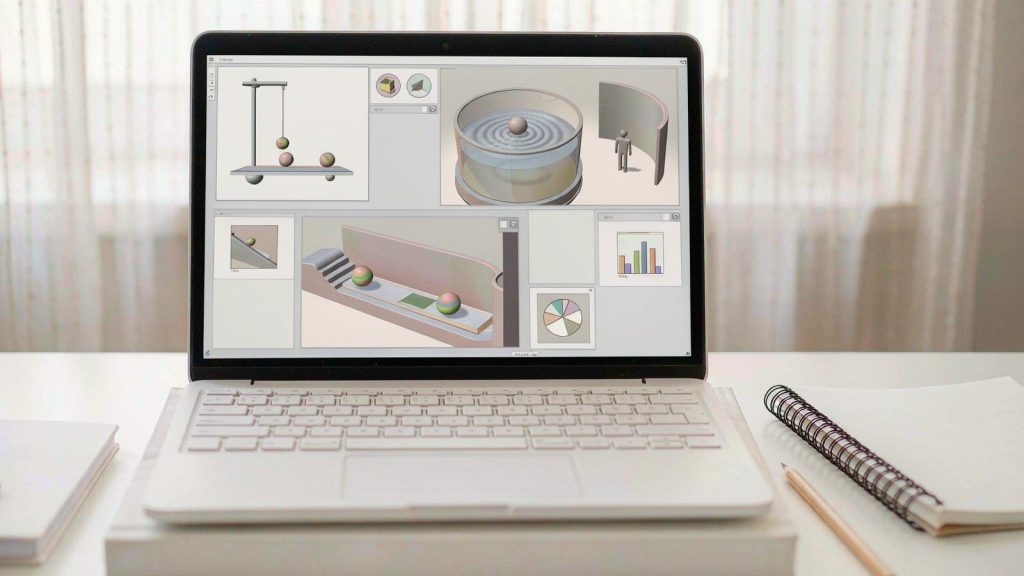
PhET covers all of these. Its simulation library includes gas properties, alpha decay, circuit construction, projectile motion, and gravity-and-orbits models. None of them is a video; they are built on equations that respond to your inputs.
This is where software genuinely cannot be substituted. You are not choosing a convenient alternative. You are choosing the only available option.
Reason 4: Repetition is free
In a simulation, changing a parameter and re-running costs one click. In the kitchen, it costs five minutes of setup. If you want a child to see what happens as you vary one variable across ten values, the physical version is thirty to fifty minutes and the simulation is about ninety seconds.
For exploratory learning — what happens if I make it heavier? what if I make it longer? — the simulation wins on sheer iteration count. That is a real pedagogical advantage, not a convenience.
Where the line falls: what simulation deletes
Now the other side, and this is where most families overestimate what they are getting.
It deletes the failure modes that teach
Real equipment fails in instructive ways. The spring stretches past its elastic limit and does not return. The thermometer reads wrong because it is in a draught. The glass beaker cracks because someone put cold water in a hot one.
Each of those failures teaches something a simulation cannot: that measurements have conditions, and that violating the conditions produces wrong numbers rather than no numbers. A simulation will happily give you a clean answer to a badly designed experiment, because it does not know you designed it badly.
This is the biggest hidden cost. A child who has only run simulations has never experienced data that was wrong in a way they did not notice.
It deletes the physical intuition
Ask someone who has only used a simulation how heavy a 5 kg mass feels, or how hot 60 °C water is to the hand, or how loud 90 dB is. They will not know. Numbers on a slider do not map onto a body.
Physical intuition is not a soft extra. It is what lets a person sanity-check a result later — knowing that a calculated answer of 500 kg for a bicycle is wrong because you know what a bicycle feels like.
It deletes collaboration and the mess
Setting up apparatus with another person requires negotiation: who holds, who reads, who records. That is where a lot of the actual learning happens, and it is completely absent when one person drives a mouse.
It deletes the surprise
Real experiments produce things you did not predict. The plant grows toward the window even though you covered the top. The pendulum's period changes when you use a heavier bob after all — because the string stretched.
Simulations only produce what their equations contain. If the programmers did not model it, it does not happen. That makes them excellent for confirming known physics and poor for encountering the unexpected.
The practical split
The line is not "simulation for theory, hands-on for fun." It is more specific:
| Purpose | Use | Why |
|---|---|---|
| Establish an ideal relationship | Simulation | Noise would hide the effect |
| Test a variable across many values | Simulation | Iteration cost is near zero |
| Experiment that is unsafe or impossible | Simulation | No alternative |
| Learn that instruments lie | Hands-on | Simulation has no instrument error |
| Learn material properties and safety | Hands-on | Cannot be modelled |
| Learn measurement technique | Hands-on | Requires a real instrument |
| Encounter the unexpected | Hands-on | Simulation only contains what was coded |
| Build physical intuition | Hands-on | Numbers do not map to a body |
A workable pattern: run the simulation first, then the physical version of the same experiment.
Simulation first, because it establishes the ideal relationship with clean data — the child knows what they are looking for. Then physical, because now every deviation becomes interesting: why is our number 8% off? Because of friction? Because of reaction time? Because the table is not level?
Do it the other way round and the physical mess comes first, the data is unreadable, and the child concludes that the experiment did not work. Simulation-first turns mess into a discussion. That is the highest-value sequence, and it costs nothing extra.
How to use PhET specifically
PhET Interactive Simulations is free, runs in a browser, needs no account for most simulations, and is funded by the University of Colorado Boulder together with grants rather than by subscription.
A few things that make it more usable than it first appears:
The teaching tips are hidden but real. Each simulation has an accompanying page with learning goals, suggested activities and common student misconceptions. These are written by the development team, not by a marketing department, and they are more useful than most paid lesson plans.
There are translations. The interface is available in many languages, which matters for bilingual households.
The simulations are built on physics engines, not animations. This is the difference between a tool and a video. If you change the mass, the period changes according to the real relationship. You can verify this: run the pendulum, double the length, and check whether the period changes by √2. If it does, the underlying model is real.
HTML5 versions work on tablets. Older Java versions are retired; use the HTML5 simulations only.
The one mistake to avoid
Do not use a simulation as a substitute for an experiment you could actually do.
The temptation is real: the simulation is cleaner, faster, and does not require buying anything. But if the physical version is available to you, skipping it means skipping the parts that produce intuition, technique and surprise — which is most of what a child takes away ten years later.
Use simulation for what it uniquely enables. Use the kitchen for what only the kitchen teaches. The families who get this right are not the ones with the best software; they are the ones who know which question they are answering.