—
Fossils are rare because turning a living thing into stone requires four conditions to line up at the same time: rapid burial, low oxygen, hard parts or mineral replacement, and long-term geological stability. Most organisms die, decay, and disappear without leaving anything behind. The fossil record is the small fraction of life that happened to meet all four conditions.
Most living things leave no trace
A dead animal on the forest floor is usually gone within weeks. Scavengers eat it, bacteria and fungi break it down, and the soft parts, muscle, skin, and organs, vanish first. Even bones and shells are slowly dissolved by soil acids or scattered by animals. For anything to survive long enough to become a fossil, it has to be removed from the normal recycling system almost immediately.
That is why the fossil record is dominated by marine animals with hard shells and by organisms that lived in places where sediment accumulates quickly. It is not a fair sample of past life; it is a sample of past life that was buried in the right way.
Condition one: rapid burial
The first requirement is that the remains are covered by sediment before they can be destroyed. A river delta, a lake bottom, a sandbar, or a volcanic ash fall can bury a body in hours to days. Once it is sealed under mud or sand, scavengers cannot reach it and oxygen is cut off.
This is why so many fossils come from environments where sediment piles up fast: shallow seas, floodplains, deltas, and volcanic settings. A dead fish that sinks into quiet lake mud has a far better chance than one that sinks into a current-swept channel where the bottom is scoured clean.
Condition two: low oxygen
Burial alone is not enough if oxygen-rich water keeps circulating through the sediment. Decay needs oxygen, so the second condition is an oxygen-poor environment. Fine mud and organic-rich sediment use up oxygen quickly, and the result is an anoxic layer where bacterial decay slows dramatically.
Some of the most spectacular fossil deposits formed in basins where the bottom water had almost no oxygen. The Burgess Shale in British Columbia and the Solnhofen limestone in Germany are famous examples. In those settings, soft-bodied animals that would normally rot away were preserved in extraordinary detail, including impressions of guts, gills, and eyes.
Condition three: hard parts, or replacement
Hard parts fossilize most easily. Shells, bones, teeth, and wood are already mineralized or tough, and they can survive chemical attack that would destroy soft tissue. Many fossils are simply the original hard parts, sometimes slightly altered.
Soft parts need a different route. In some deposits, minerals dissolved in groundwater precipitate inside the tissue before it decays, replicating the shape. This is called permineralization, and it is how petrified wood forms. In other cases, the original mineral is dissolved and replaced atom by atom with another mineral, such as calcite replaced by silica; the shape survives even though the original material is gone. Amber and permafrost preserve soft tissue by a different mechanism, rapid entombment in resin or permanent freezing, but the principle is the same: the tissue is sealed away from decay.
Condition four: long-term stability
The last condition is time, and time is not neutral. A fossil that is buried but then uplifted, heated, and squeezed by mountain building can be destroyed by metamorphism. A fossil exposed at the surface is eroded away. To reach a collector’s hands, the fossil has to stay buried and chemically stable for thousands to hundreds of millions of years, then be exposed gently enough to survive.
This is why fossil beds are often found where sedimentary rock has been uplifted and eroded in a way that exposes layers without cooking them. The badlands of South Dakota and the limestone quarries of southern Germany both fit that pattern.
The main kinds of fossils
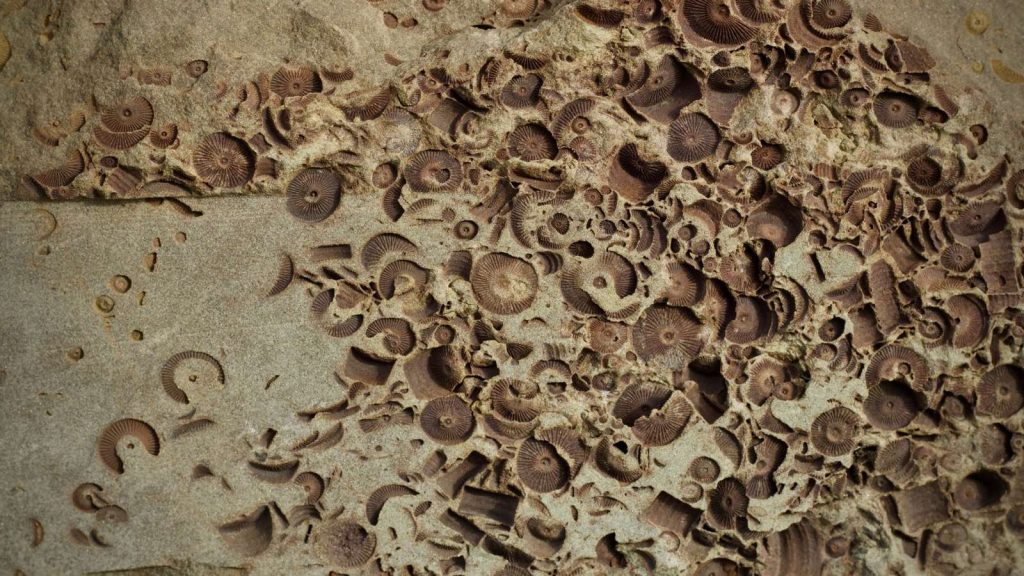
Body fossils are the remains of the organism itself: bones, shells, teeth, leaves, wood. Trace fossils are records of activity rather than the body, including footprints, burrows, feeding marks, and coprolites. Molds and casts form when an organism dissolves away and leaves a cavity that later fills with mineral. Chemical fossils are molecular traces, such as the carbon signatures of ancient life in rocks.
Each type tells a different story. A footprint records behavior; a shell records anatomy; a chemical signature can record life too small or too soft to leave a visible body. Together they give a fuller picture than any one type alone.
How long does it take?
There is no fixed schedule. Permineralization can begin within years of burial, as groundwater starts depositing minerals in bone or wood, but the process that turns sediment into solid rock usually takes thousands to millions of years. A fossil is not finished when the organism is buried; it is finished when the surrounding sediment has compacted and cemented into rock and the remains have stabilized chemically.
Some fossils form quickly. A shell buried in fine mud can be preserved well enough to collect within a human lifetime if the sediment hardens. Others take hundreds of millions of years, and the fossil we find today may have been buried, lithified, uplifted, and exposed in stages. The age of a fossil is the age of the rock around it, not the time it spent forming.
Why the fossil record is biased
The four conditions are not equally likely for all organisms. Marine animals with hard shells, living in shallow seas where sediment accumulates, are vastly overrepresented. Soft-bodied land animals, organisms that live in erosive environments, and anything that decays quickly are underrepresented or missing entirely.
That bias is not a flaw in the method; it is a property of the record that paleontologists work around. A gap in the fossil record does not mean an organism did not exist. It usually means the conditions for preservation were not met. Reading the record correctly means asking what kind of environment the fossils came from, not just what species they represent.
For how sediment becomes soil and rock at the surface, see what soil is. For the broader pattern of species disappearing, see why species go extinct. And if you want to start finding fossils yourself, the tools and safety basics are covered in rock and fossil kits for kids.