What Is Dark Energy? The Mysterious Force Expanding Our Universe
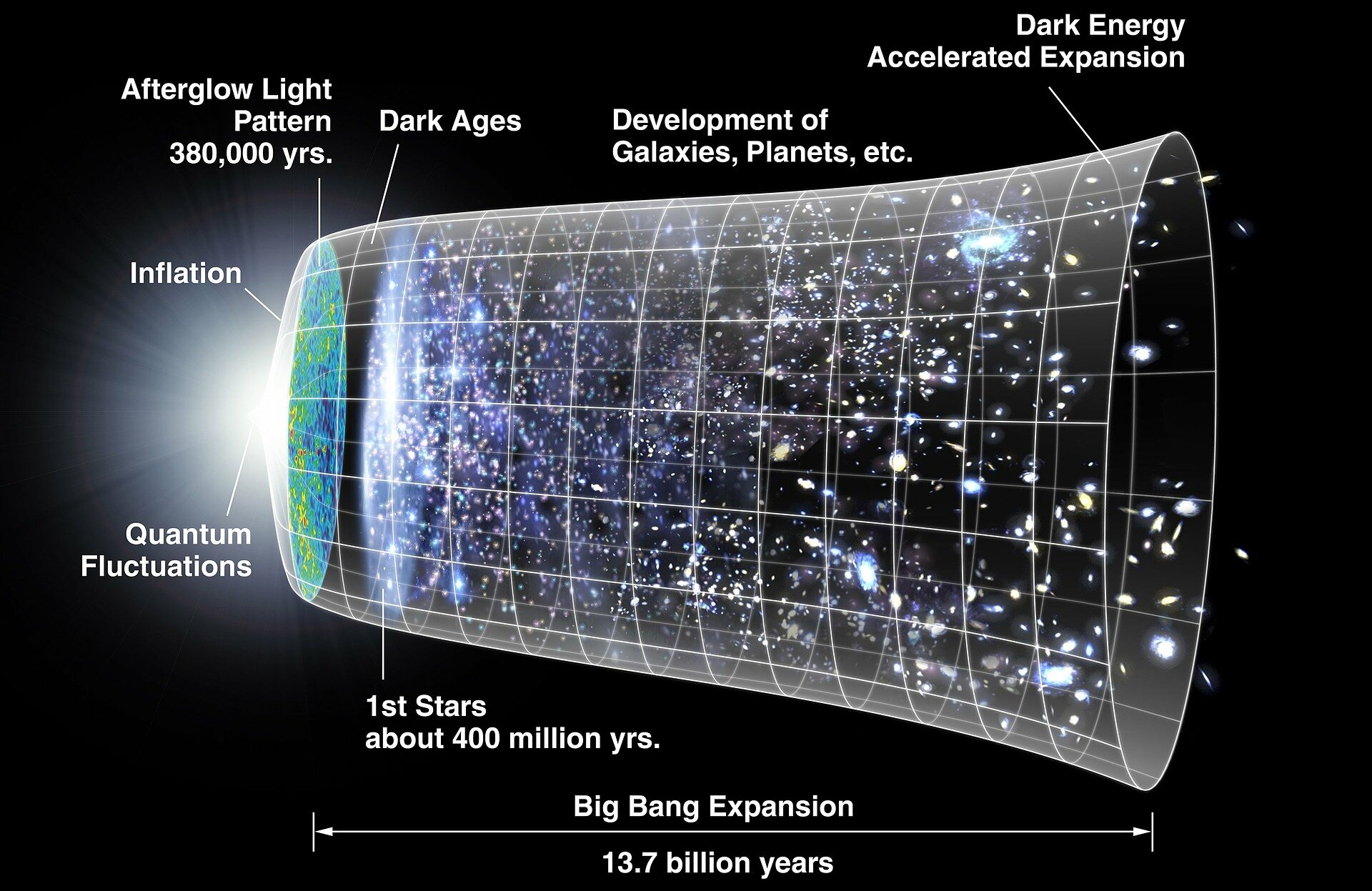
For decades, astronomers assumed the expansion of our universe was slowing down. Gravity, pulling all matter together, should gradually put the brakes on the Big Bang’s outward rush. But in the 1990s, observations of distant supernovae shocked scientists: the universe is not slowing down. It is accelerating.
The invisible cause behind this acceleration is what we call dark energy.
What Percentage of the Universe Is Dark Energy?
Current measurements suggest dark energy makes up roughly 68% of the total energy content of the universe. Dark matter accounts for about 27%. Ordinary matter — stars, planets, gas, and all living things — adds up to less than 5%.
That means most of the universe is made of something we cannot directly see or detect with telescopes.
How Did Scientists Discover Dark Energy?
Two independent teams studied Type Ia supernovae. These exploding stars act as “standard candles”: their brightness is predictable, so researchers can calculate how far away they are.
The teams found that faraway supernovae were dimmer than expected. The only explanation was that the space between us and those stars had stretched more quickly over time. The expansion of space is speeding up. This discovery won the 2011 Nobel Prize in Physics.
What Could Dark Energy Be?
The leading idea is the cosmological constant. Albert Einstein first added this term to his equations, then dismissed it as a mistake. Today, physicists think it may represent the inherent energy of empty space. Even a vacuum contains energy. As space expands, more vacuum appears, creating more dark energy, which pushes space to expand faster.