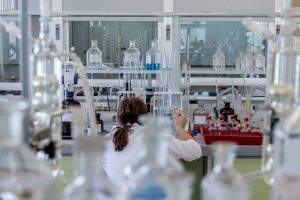
Teenagers can be insulted by anything that looks like a kids’ activity. The best science activities for teenagers produce something a stranger would take seriously: a data set, an analysis, and a written argument — and ideally one line on a transcript.
What Changes in the Teen Years
Three things. They can design their own procedure rather than follow one. They can handle apparatus that costs real money and requires care. And they need autonomy — a teenager who chooses the question will spend ten hours on it, while one assigned the same question will spend two.
So offer three questions and let them pick, rather than handing over one. The science activities for teenagers that survive to the end are almost always the ones the student argued for.
Ten Projects at a Glance
| Project | Subject | Hours | Cost |
|---|---|---|---|
| Independent research question | Any | 20-40 | Low |
| Home microscopy survey | Biology | 10-15 | Medium |
| Quantitative titration | Chemistry | 6-10 | $30 |
| Enzyme kinetics with catalase | Biology/Chem | 8-12 | Low |
| Data analysis of a public set | Data science | 15-25 | $0 |
| Building and calibrating sensors | Physics/Electronics | 20-30 | $40 |
| Long-term ecology transect | Environmental | 20+ | $0 |
| Spectroscopy with a diffraction grating | Physics/Chem | 8-12 | $20 |
| Astronomy imaging project | Astronomy | 15-25 | Medium |
| Citizen science contribution | Any | 10+ | $0 |
The Independent Research Project
This is the one worth most. The student picks a question narrow enough to answer in a month, writes a hypothesis, designs the procedure, runs it, and writes it up in a standard format: question, background, method, results, discussion, limitations.
The single most common failure is a question that is too broad. “Does music affect plant growth” is unanswerable at home; “does 30 minutes of 90 dB sound daily change the height of radish seedlings over 14 days” is testable by Tuesday.
Home Microscopy
A decent student microscope opens up an entire year of work: pond water surveys, onion root squashes, pollen comparison, and cheek cells. Pair it with a phone adapter and the student can build a labelled image catalogue.
Measuring is what makes this real science rather than looking. Estimate cell size using a known scale, count organisms per drop, and repeat across samples.
Quantitative Chemistry
With a scale, a graduated cylinder, and a pH indicator, a teenager can run an acid-base titration on vinegar and calculate concentration. Add a temperature probe or a cheap pH meter and they can do enzyme kinetics: catalase from potato, hydrogen peroxide, and oxygen output against temperature.
Both produce numbers, both produce curves, and both look like real lab work on a transcript.
Data Science Without Equipment
Public data sets are free and enormous. A student can download local weather records, stream-flow data, or species observations and test a real question against ten years of measurements. No apparatus, no consumables, genuinely publishable analysis.
Teach one spreadsheet skill at a time: filtering, then pivot summaries, then scatter plots and trend lines. Three skills cover most of what a first-year undergraduate does.
How to Write It Up
- Abstract: four sentences, written last
- Method: detailed enough that someone could repeat it
- Results: tables and graphs, with the written part describing only what the data shows
- Discussion: what it means, what went wrong, what you would do next
- References: cite them properly, even if there are only three
The discussion section is where marks live. A student who can say “my data does not support my hypothesis, and here are three reasons why” has learned more than one whose data fitted perfectly.
Turning It Into Credit
Log the hours as you go — 20 hours of genuine work on one project is a fifth of a credit. Keep the report in the portfolio, photograph the apparatus, and write a one-paragraph course description at the end. Two substantial projects plus a structured reading programme is a defensible year.
Keep Exploring
- How to record homeschool science credits — logging the hours
- Best microscopes for students — if you are buying one
- Science fair project ideas — questions that are testable