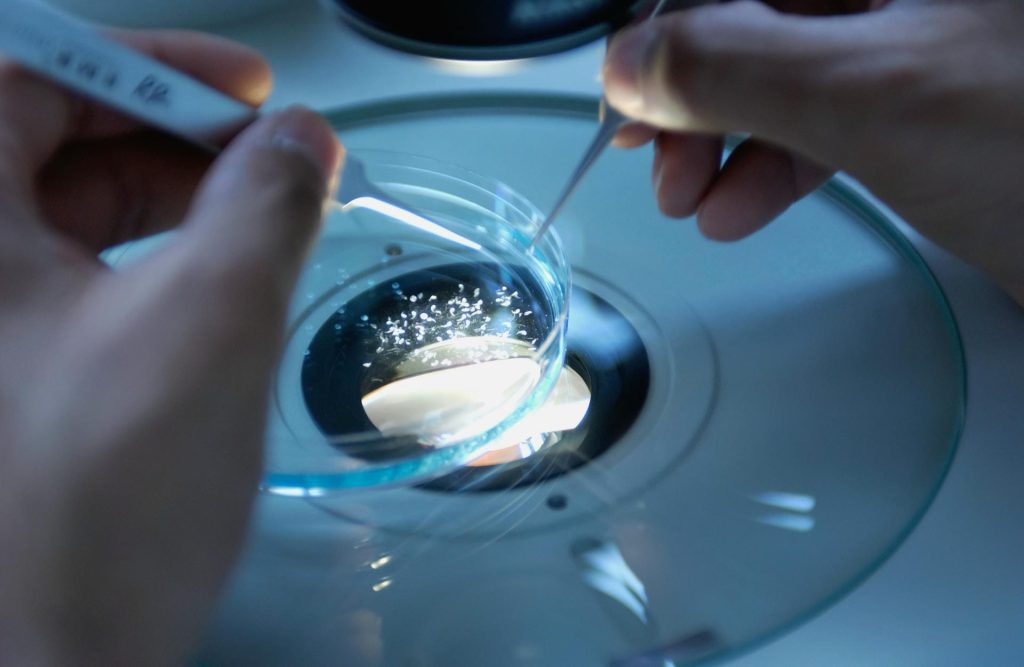
In 1847 a Hungarian doctor named Ignaz Semmelweis noticed that women delivered by medical students died of childbed fever at several times the rate of women delivered by midwives. He worked out why, proved it by making students wash their hands, and cut the death rate from about 18% to roughly 1%. His colleagues rejected him, and he died in an asylum at 47. How was germ theory discovered, given that the evidence was sitting in a Vienna hospital in 1847? Slowly, and against a great deal of resistance.
What People Believed First
The dominant explanation was miasma — the idea that disease came from bad air, from swamps and decay and foul smells. It explained some real patterns: cholera did cluster around polluted water, which was often also smelly. The competing idea, contagion, was older but had no mechanism. Nobody knew what was actually being transmitted.
Semmelweis and the Cadaver Particles, 1847
Semmelweis’s insight came from an accident. A colleague, Jakob Kolletschka, died after being cut by a scalpel during an autopsy — with symptoms matching the women dying of childbed fever. Semmelweis reasoned that something from the cadavers was being carried on the students’ hands from the autopsy room to the delivery room.
He ordered handwashing with chlorinated lime. Mortality in his clinic fell dramatically. It is one of the cleanest natural experiments in medical history — and it convinced almost nobody, because handwashing implied the doctors themselves were killing their patients.
Pasteur: Germs Are Real, and They Do Things
Louis Pasteur got there from an entirely different direction. Hired by a distillery in 1856 to figure out why beet juice went sour, he showed that fermentation was carried out by living microorganisms, not by a chemical reaction. Different organisms produced different products — yeast produced alcohol, bacteria produced lactic acid.
Then he settled the argument about spontaneous generation. His 1859 swan-neck flask experiments showed that sterile broth stayed sterile indefinitely when dust and microbes could not reach it. Life came from life. Pasteur went on to identify the silkworm pathogen in 1865 and develop vaccines for chicken cholera and anthrax.
Koch: How to Prove a Specific Germ Causes a Specific Disease
Robert Koch supplied the method. In 1876 he traced anthrax through its full life cycle, showing that Bacillus anthracis formed spores that survived in soil and caused disease in animals. In 1882 he identified the tuberculosis bacterium; in 1883, cholera.
His postulates set the standard: find the organism in every case of the disease, grow it in pure culture, show that it causes the disease in a healthy host, and recover it again. They are not perfect — some pathogens cannot be cultured, some cause no disease in animals, and viruses are not free-living organisms at all — but they defined what a causal claim in microbiology had to look like.
Lister and the Surgery That Stopped Killing People
Joseph Lister read Pasteur’s work and asked the obvious question: if germs cause decay, do they cause wound infections? From 1865 he began treating surgical wounds with carbolic acid, and his amputation mortality rate dropped from roughly 45% to about 15%.
The technique was unpleasant — carbolic acid burned surgeons’ hands — and many resisted it for years. Acceptance came fastest in Germany, where Koch’s methods gave surgeons a way to measure contamination.
| Name | Year | Contribution |
|---|---|---|
| Ignaz Semmelweis | 1847 | Showed handwashing cut childbed fever deaths from ~18% to ~1% |
| Louis Pasteur | 1856-1865 | Proved fermentation and decay are caused by living microorganisms |
| Joseph Lister | 1865 | Introduced antiseptic surgery using carbolic acid |
| Robert Koch | 1876-1883 | Isolated anthrax, tuberculosis, and cholera; set the causal standard |
Why It Took So Long
So how was germ theory discovered and accepted? Not by one decisive experiment but by the accumulation of several independent lines of evidence: Semmelweis’s mortality statistics, Pasteur’s fermentation chemistry, Koch’s cultures, Lister’s surgical outcomes. Each alone could be dismissed. Together they could not.
None of them could see the organism doing the work. Bacteria are roughly 1 to 5 micrometres across — visible under a good 19th-century microscope, but the connection between “I see rods in this fluid” and “these rods cause this disease” required a method nobody had yet written down. The theory had to be built before the evidence could count.
Keep Exploring
- Who discovered penicillin? — the next revolution, and another credit fight
- History of the periodic table — the same era, a different kind of evidence
- 5 science myths that refuse to die — including several about germs



1 thought on “How Was Germ Theory Discovered? Handwashing, Fermentation, and a 40-Year Fight”