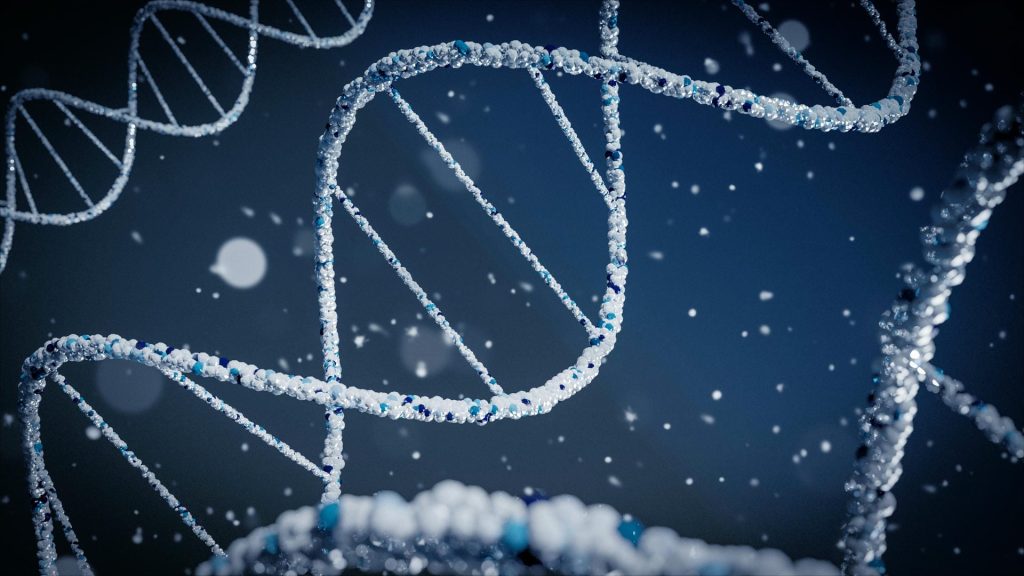
Every cell in your body carries about 6 feet of DNA, packed into a space a thousand times narrower than a human hair. Your body has roughly 30 trillion cells. Laid end to end, the DNA inside you would stretch billions of miles. So how does dna work as a physical object? It is a tape measure of instructions: four chemical letters, read in groups of three, each triplet naming one building block.
The Short Answer
DNA stores information in the order of four bases — adenine (A), thymine (T), guanine (G), and cytosine (C). A always pairs with T; G always pairs with C. That pairing rule is what makes copying possible, and it is the whole trick. The sequence is read in three-letter words called codons, and each codon specifies either one amino acid or a stop instruction.
The Structure
Two strands run in opposite directions and twist into a double helix. The sugar-phosphate backbone sits on the outside; the bases point inward and pair across the middle. The helix makes one full turn every 10 base pairs, and the two grooves it creates are where proteins bind to read the sequence.
Weak hydrogen bonds hold the two strands together — weak enough to be unzipped by enzymes, strong enough to hold in a crowded cell. The strong bonds, the ones that chain letters together along a strand, are covalent. Same molecule, two different kinds of glue, used for two different jobs.
How It Copies Itself
DNA polymerase does the copying. It unzips the double helix, reads each exposed base, and attaches the matching partner. Because A only fits T and G only fits C, one strand becomes two identical double helices.
The enzyme is fast and accurate — it adds roughly 50 nucleotides per second in human cells and errors around one in a billion bases, thanks to a built-in proofreading function that backs up and removes mismatches. After proofreading, the final error rate is closer to one in 10 billion. Nearly every mutation that makes you different from any other human started as one of those rare errors.
From DNA to Protein
This is the part that explains how does dna work without a nucleus full of tiny builders: DNA is a library, not a factory. It never leaves the nucleus. Instead it is transcribed into messenger RNA, which is edited and shipped out to ribosomes. Ribosomes read the mRNA three letters at a time, and transfer RNA molecules bring the matching amino acid. The amino acids chain together and fold into a protein.
That two-step arrangement solves a practical problem. It lets one gene be read many times without risking the master copy, and it gives the cell a place to adjust how much of a protein gets made.
The Code Itself
| Codon | Meaning |
|---|---|
| AUG | Start; also codes for methionine |
| UUU, UUC | Phenylalanine |
| GGA, GGC, GGG, GGU | Glycine — four codons, one amino acid |
| UAA, UAG, UGA | Stop — three separate stop signals |
With four letters in groups of three there are 64 possible codons but only 20 amino acids, so the code is redundant: most amino acids have several codons. That redundancy is not just sloppiness — it buffers against some mutations, since a change in the third letter often still codes for the same amino acid.
The code is also nearly universal. The same codon means the same thing in a bacterium, a rose, and a whale, which is strong evidence that all life descends from a common ancestor — and the reason a human gene can be inserted into bacteria to produce insulin.
Where the Variation Comes From
Most of the three billion letters in your genome are identical to everyone else’s. The differences — roughly one letter per 1,000 — plus structural variation account for the variation between people. Most of it does nothing at all. Some of it changes one protein slightly. A small fraction has a measurable effect on health or appearance.
Keep Exploring
- What is a cell? — where DNA lives and why it stays there
- How do enzymes work? — what most of those proteins actually do
- What is CRISPR? — editing the code directly
2 thoughts on “How Does DNA Work? Four Letters That Build a Body”