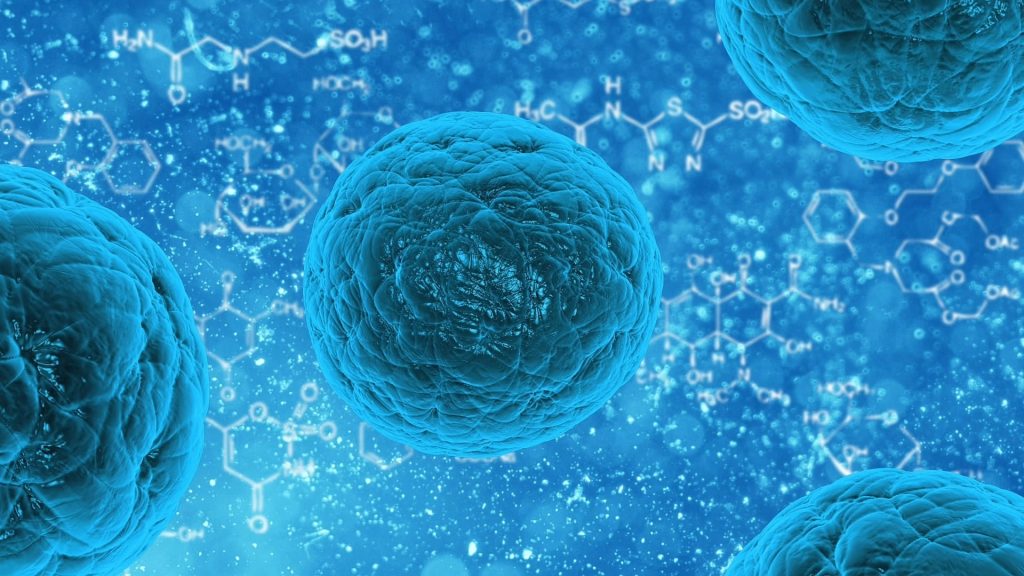
Your body holds somewhere around 30 trillion cells, and you also host roughly 38 trillion bacteria — which means most of the cells in “you” are not human. Ask a biologist what is a cell and you get a definition with three parts: a membrane that separates inside from outside, a set of instructions, and a way to turn those instructions into matter. Anything with all three is alive. Anything missing one is not.
The Short Answer
A cell is a self-contained chemical factory wrapped in a membrane. It takes in raw materials, runs reactions using instructions encoded in DNA, builds the molecules it needs, and copies itself. Cells are the smallest units that do all of this unaided, which is why “cell” and “life” are almost synonyms.
Two Very Different Designs
| Feature | Prokaryotes (bacteria, archaea) | Eukaryotes (plants, animals, fungi) |
|---|---|---|
| Nucleus | No — DNA floats in the cytoplasm | Yes — DNA enclosed in a membrane |
| Organelles | Few, none membrane-bound | Many: mitochondria, ER, Golgi |
| Size | Typically 1-5 micrometres | Typically 10-100 micrometres |
| DNA shape | Usually one circular chromosome | Multiple linear chromosomes |
| Life | Always single-celled | Single-celled or multicellular |
The gap between the two is one of the largest discontinuities in biology. Eukaryotic cells are typically 1,000 to 10,000 times larger by volume, and carry internal compartments that prokaryotes simply do not have.
The Membrane: A Wall That Is Also a Door
The cell membrane is a double layer of phospholipids — molecules with a water-loving head and two water-hating tails. In water they spontaneously arrange themselves into a sheet with heads out and tails in, and that sheet closes into a bubble. No assembly required; it is physics doing the work.
That bubble would be a prison if it were sealed. Embedded proteins act as channels and pumps, deciding what gets through. Some let ions pass only when a signal arrives; others burn energy to push molecules against their concentration gradient. A working cell spends a large share of its energy budget running these pumps.
What Is Inside, and What Each Part Does
| Part | Job |
|---|---|
| Nucleus | Stores DNA; controls which genes get read |
| Mitochondria | Generate ATP, the cell’s energy currency |
| Ribosomes | Assemble proteins from amino acids |
| Endoplasmic reticulum | Folds and ships new proteins; makes lipids |
| Golgi apparatus | Sorts and packages molecules for delivery |
| Lysosomes | Digest worn-out parts and invaders |
| Cytoskeleton | Gives shape; moves materials around |
Mitochondria deserve a second look. They have their own circular DNA, their own ribosomes, and they divide on their own schedule. That is because they were once free-living bacteria, engulfed by an ancestral cell roughly 1.5 billion years ago and never let go. Every mitochondrion you own descends from that single event.
Why Cells Do Not Just Get Bigger
If bigger were better, one enormous cell would work fine. It does not, because of surface area to volume ratio. Double a cell’s radius and its surface area goes up fourfold while its volume goes up eightfold. The membrane is how a cell eats and breathes, so past a certain size the surface cannot keep the interior supplied.
That is why large organisms are multicellular rather than just big. A whale is not one giant cell; it is trillions of small ones, each with a manageable surface-to-volume problem. Where single cells do get large — a bird’s egg, some algae — they cheat with folds, thin shapes, or by storing mostly inert material.
Where New Cells Come From
Only from other cells. There is no known natural process that builds a cell from scratch; they divide. A human cell copies its 3 billion base pairs, then splits in two. Most cells in your body are replaced on a schedule: gut lining every few days, red blood cells every 120 days, skin roughly monthly. Some neurons are never replaced at all and have to last your entire life.
That is also the sharpest answer to what is a cell from another angle — not really an object at all, but a lineage of divisions stretching back billions of years.
Keep Exploring
- How does DNA work? — the instructions stored inside every cell
- How do enzymes work? — the molecular machines that run the chemistry
- Biology experiments at home — look at real cells with kitchen equipment

1 thought on “What Is a Cell? The Smallest Unit That Counts as Alive”