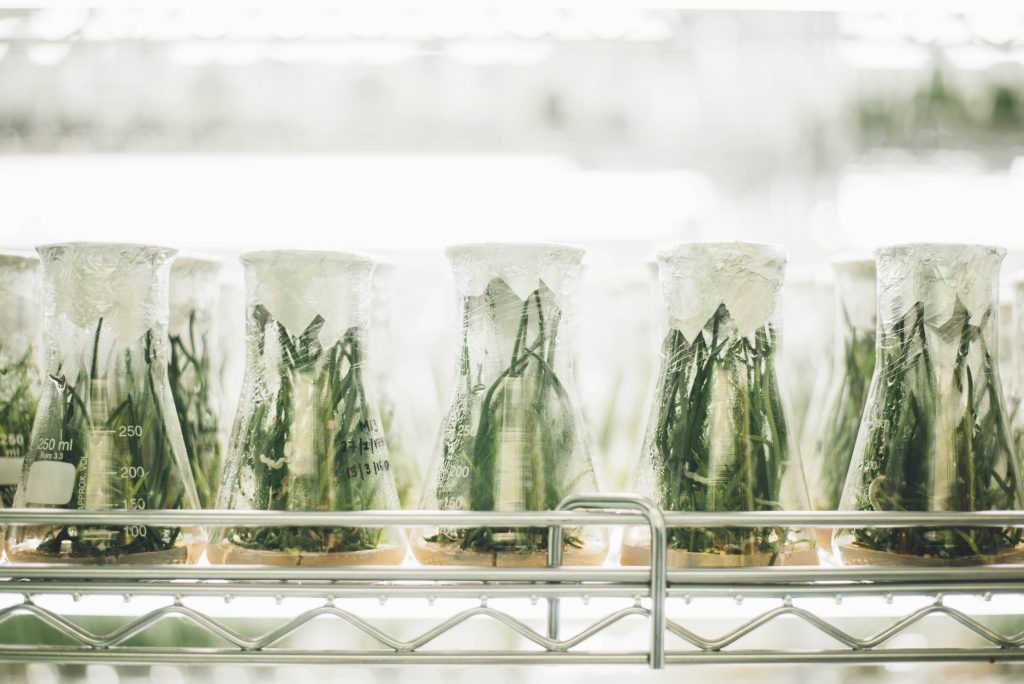
Biology experiments at home have one structural difference from chemistry or physics: they take days to weeks rather than minutes. That is the tradeoff — slower payoff, but the results are about living things, which most kids find more interesting than a colour change.
Everything below uses kitchen or garden materials. Two involve mould, so check the safety notes.
1. Seed Germination (The Classic)
Place bean or cress seeds on damp cotton wool in a clear jar so you can see through the side. Keep damp, not soaked.
What you observe: root emerges first, then the shoot, and the root grows downward regardless of how the seed is oriented.
Variable to test: turn the jar halfway through. The root curves back down — that is gravitropism, and watching it happen is genuinely striking.
Time: 3-7 days.
2. Light Versus Dark
Two identical planted containers. One on a windowsill, one in a closed cupboard. Water both equally.
| Condition | Likely result |
|---|---|
| Light | Green, sturdy, growing toward the window |
| Dark | Pale yellow, spindly, taller but weaker |
Why: in the dark the plant stretches desperately searching for light — that is etiolation. Without light it cannot make chlorophyll, so it is pale.
Time: 7-10 days. This is the single best plant experiment for a science fair.
3. Celery or Carnation Capillary Action
Put a celery stalk with leaves, or a white carnation, in water with strong food colouring.
What you observe: within hours the colour travels up into the leaves or petals. Slice the stem crosswise and you can see the coloured tubes.
Why: xylem vessels carry water upward by capillary action and transpiration pull. No pump involved.
Variable: warm versus cold water, or coloured versus plain. Time: a few hours to a day.
4. Leaf Chromatography
Crush a green leaf in rubbing alcohol (adult supervision — alcohol and solvent fumes), put a strip of coffee filter in, and wait.
What you observe: the pigment separates into bands — greens, and often yellows and oranges.
Why: the green chlorophyll has been hiding carotenoids all along. This is the same mechanism as autumn colour.
Try: a green leaf versus an autumn-coloured one. Time: 30-60 minutes.
5. Enzyme Test: Pineapple and Jelly
Make jelly (gelatin) in two bowls. Add fresh pineapple to one, tinned pineapple to the other.
What you observe: the fresh pineapple one does not set. The tinned one does.
Why: fresh pineapple contains bromelain, an enzyme that digests the gelatin protein. Tinning heats it enough to destroy the enzyme.
This is a real experiment with a real control, and the result is dramatic. Time: overnight.
6. Bread Mould Growth
Put a slice of bread in each of three sealed bags: one dry, one with a few drops of water, one kept in the fridge. Seal them and do not open them.
What you observe: the damp, warm one moulds fastest. The dry and cold ones lag badly or stay clean.
Why: mould needs moisture and warmth. This is why bread goes off faster in summer and why fridges work.
Safety: keep sealed, throw away without opening, wash hands. Do not do this if anyone at home has a mould allergy or asthma. Time: 5-10 days.
7. Flower Dissection
Take a large flower — a lily or tulip works well — and pull it apart carefully. Identify sepals, petals, stamen (with pollen), and pistil. Use a magnifier if you have one.
What you are doing: real botany. Sketch what you find and label it.
Extension: collect pollen on a fingertip and look at it under a microscope if you have one. Pollen grains are spectacularly varied by species.
8. Yeast Respiration
Mix yeast, sugar, and warm water in a bottle, then stretch a balloon over the neck.
What you observe: the balloon inflates over 30-60 minutes.
Why: yeast metabolises the sugar and releases CO2. This is fermentation, and it is how bread rises.
Variable: sugar versus no sugar, warm versus cold water. The no-sugar and cold versions barely inflate, which makes the point cleanly.
Making It Proper Science
With those two rules, biology experiments at home produce results you can actually defend.
Biology rewards patience but punishes sloppiness, because living things vary a lot. Two rules that fix most of it:
- Use several subjects, not one. Ten seeds, not one seed. Individual variation is huge, and a single seedling that died tells you nothing.
- Change one thing and control everything else. Same water, same light, same soil — only your variable differs. Otherwise you cannot attribute the result to anything.
Photograph daily. A time series is far more convincing than a description written at the end, and it is the easiest mark-gainer available.
Related Reading
- How plants turn sunlight into food — what experiment 2 is testing
- Best microscopes for students — the upgrade that opens this up
- Science fair project ideas — more options

2 thoughts on “Biology Experiments at Home: 8 That Do Not Need a Lab”