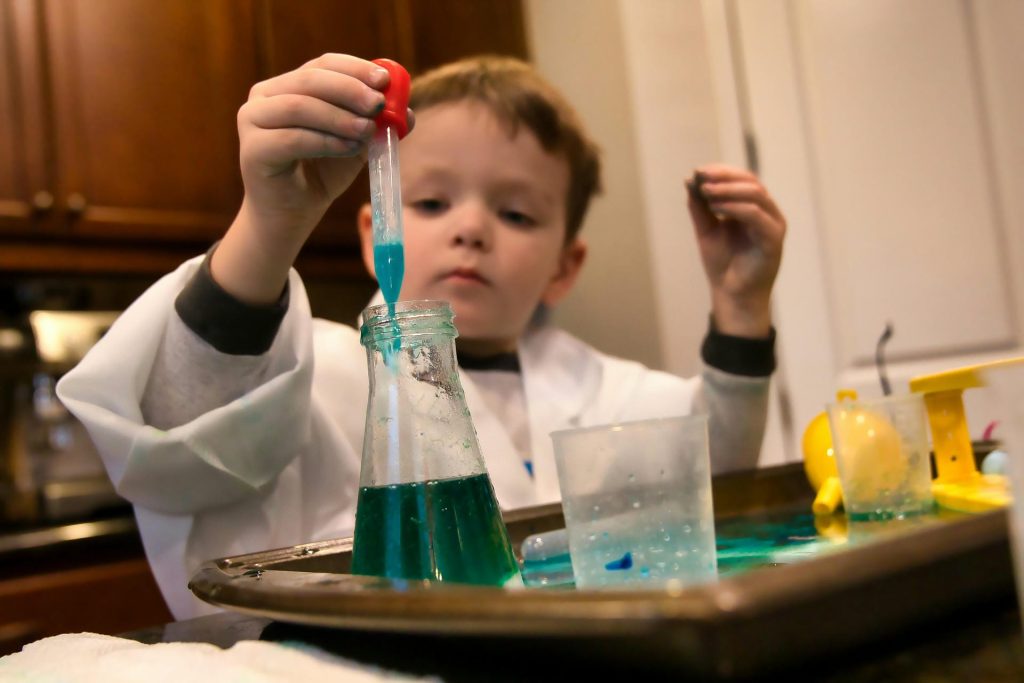
Looking for easy chemistry experiments at home that actually produce a reaction worth watching? Everything below uses things you almost certainly already have, and every one includes why it happened — because a colour change with no explanation is a party trick, not science. Safety notes are included where they matter.
Before You Start
- Eye protection if you have it, especially for anything acidic
- Cover the surface — baking soda volcanoes go further than you think
- Do not eat or drink anything used in an experiment, even if it is food
- Have a grown-up present for anything involving vinegar, lemon juice, or heat
1. Baking Soda and Vinegar (Acid + Base)
Put baking soda in a container, add vinegar, watch it foam. The reaction produces carbon dioxide gas:
Sodium bicarbonate + acetic acid → sodium acetate + water + carbon dioxide
Make it an experiment rather than a demo by varying the temperature of the vinegar or the ratio of the two, and timing how long the fizzing lasts.
2. Red Cabbage Indicator (pH)
Chop red cabbage, boil it in water for ten minutes, and keep the purple liquid. It contains a pigment that changes colour with pH:
| Substance added | Colour | Means |
|---|---|---|
| Lemon juice / vinegar | Pink to red | Acidic |
| Water | Purple | Neutral |
| Baking soda solution | Blue to green | Basic |
| Soap solution | Green to yellow | Strongly basic |
Test everything in the kitchen. This is the single best pH experiment available at home.
3. Invisible Ink with Lemon Juice
Write with lemon juice using a cotton bud, let it dry completely, then hold the paper near (not in) a warm lamp or ask an adult to iron it. The writing appears brown.
Why: lemon juice is acidic and weakens the paper fibres. It also oxidises and browns when heated, faster than the surrounding paper does.
4. Milk Plastic (Casein Polymer)
Warm a cup of milk (adult handles the heating), stir in four teaspoons of vinegar, and watch it separate into curds and whey. Strain the curds, press them, and leave to dry overnight — you get a hard, plastic-like solid.
Why: acid makes the casein protein unfold and clump together. This is genuinely how early plastics were made from milk.
5. Density Tower
Layer honey, dish soap, water, vegetable oil, and rubbing alcohol slowly in a tall glass, pouring each down the side. They stack in order of density. Drop in small objects and see where each one settles.
Why: each liquid has a different density, and less dense liquids float on denser ones.
6. Elephant Toothpaste
In a bottle, mix hydrogen peroxide (3% is fine), a good squeeze of dish soap, and food colouring. Add a spoonful of yeast dissolved in warm water and stand back.
Why: yeast catalyses the decomposition of hydrogen peroxide into water and oxygen. The soap traps the oxygen as foam. This one is genuinely dramatic — do it outside.
7. Rusting Nail (Oxidation)
Put steel wool or an ungalvanised nail in water and leave it for a week. Compare against a dry control and one in salt water.
Why: iron oxidises in the presence of oxygen and water, and salt accelerates it dramatically. This is a real experiment because it has a control and a variable.
8. Dissolving Eggshell
Put a raw egg in vinegar and leave it for 24-48 hours. The shell dissolves, leaving a rubbery membrane-held egg.
Why: calcium carbonate in the shell reacts with the acid, releasing CO2. The bubble-covered egg on day one is the gas being produced.
9. Chromatography
Draw a line near the bottom of a coffee filter strip with a felt-tip pen (black works best), dip the end in water, and watch the colours separate as the water climbs.
Why: different pigment molecules travel at different speeds through the paper fibres. Black ink is a mixture, and this reveals it.
10. Homemade Lava Lamp
Fill a bottle mostly with oil, add water until nearly full, drop in food colouring, then add half an Alka-Seltzer tablet.
Why: oil and water do not mix, and water is denser. The tablet produces CO2 bubbles that carry coloured water up through the oil, then pop and let it sink again.
11. Cabbage vs Baking Powder
Test baking powder and baking soda separately with your cabbage indicator and with vinegar. Baking powder fizzes with water alone; baking soda does not.
Why: baking powder already contains a dry acid. Baking soda needs an added one. That difference is why recipes specify one or the other.
12. Crystal Garden
Dissolve as much salt or sugar as will dissolve in hot water, hang a string in it, and leave it for several days. Crystals grow on the string as water evaporates.
Why: a hot solution holds more dissolved solute than a cold one. As it cools and evaporates, the excess comes out of solution as ordered crystals.
How to Turn These Into Real Experiments
All twelve of these easy chemistry experiments at home work with supermarket ingredients.
The step most people skip: change one thing and predict the outcome first. Guess, then test, then compare. A prediction written down before you look is what separates an experiment from a demonstration — and being wrong is the interesting part.
Related Reading
- More science experiments at home
- How to grow crystals at home — experiment 12 in detail
- Best chemistry sets for kids — when you want real reagents


1 thought on “Easy Chemistry Experiments at Home: 12 You Can Do Today”